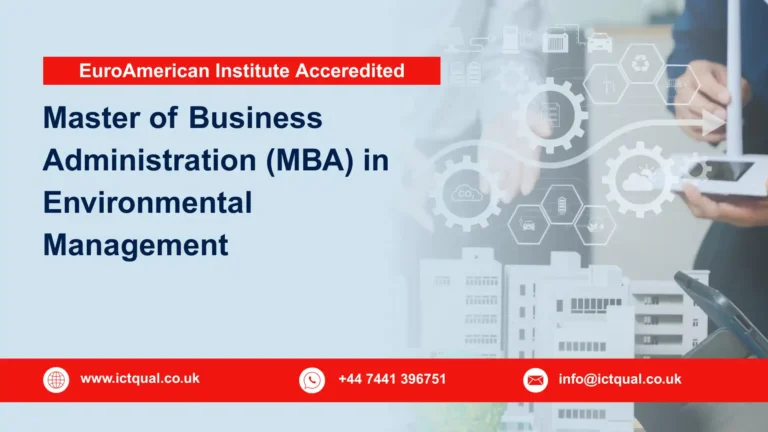
ICTQual Level 3 Diploma In Environmental Management

Accredited by ICTQualAB

Start Learning Today

The ICTQual Level 3 Diploma in Environmental Management is a practical and knowledge-based qualification designed for individuals who want to understand and manage environmental issues effectively. This course provides learners with a clear understanding of environmental principles, sustainability practices, and the importance of protecting natural resources in today’s world.

Through this program, learners explore key topics such as environmental policies, waste management, pollution control, and resource conservation. It helps individuals understand how human activities impact the environment and how these impacts can be reduced through responsible planning and management. The course also highlights the importance of following environmental regulations and promoting sustainable practices in different industries.

The ICTQual Level 3 Diploma in Environmental Management is suitable for beginners as well as those already working in related fields. It builds awareness and develops practical skills that can be applied in real-life situations. By completing this course, learners gain the confidence to support environmental protection efforts and contribute to a more sustainable and responsible future.

Prerequisites

Course Entry Requirements

To enrol in the ICTQual Level 3 Diploma in Environmental Management, learners should meet the following basic requirements:

  • Minimum Age: Learners should be 18 years or older to handle advanced management responsibilities.
  • Educational Background: A Level 2 qualification or equivalent is recommended. Basic knowledge of science or environmental studies can be helpful but is not essential.
  • Work Experience :No prior experience is required for this course. It is suitable for beginners as well as individuals interested in environmental management.
  • Language Proficiency:Learners should have a basic level of English proficiency to understand course materials and complete assessments effectively.

Course Content

Detailed Curriculum Structure

  • Introduction to Environmental Management
  • Environmental Policy and Legislation
  • Sustainable Development
  • Waste Management
  • Renewable Energy
  • Conservation and Biodiversity
  • Environmental Impact Assessment (EIA)
  • Environmental Risk Management
  • Water Resource Management
  • Climate Change and Its Impacts
  • Environmental Economics

Learning Outcomes for the Study Units:

1. Introduction to Environmental Management

  • Understand fundamental concepts: Grasp the basic principles and concepts of environmental science and management.
  • Identify key environmental issues: Recognize and describe major environmental problems and their global significance.
  • Explain the evolution of environmental management: Trace the history and development of environmental management practices.

2. Environmental Policy and Legislation

  • Understand environmental laws: Comprehend the structure and function of international and national environmental policies and legislation.
  • Conduct environmental impact assessments: Perform and understand the steps involved in environmental impact assessments.
  • Ensure regulatory compliance: Apply knowledge to ensure adherence to environmental laws and regulations.

3. Sustainable Development

  • Understand sustainability principles: Grasp the core principles of sustainable development.
  • Apply sustainability practices: Implement sustainable practices in various business and environmental contexts.
  • Evaluate sustainable development goals: Analyze and assess the effectiveness of sustainable development initiatives.

4. Waste Management

  • Understand waste management strategies: Comprehend the principles of waste reduction, recycling, and disposal.
  • Implement waste management practices: Apply waste management techniques to minimize environmental impact.
  • Manage hazardous waste: Identify and manage hazardous waste in compliance with regulations.

5. Renewable Energy

  • Understand renewable energy sources: Identify and describe different types of renewable energy.
  • Evaluate renewable energy technologies: Assess the benefits and challenges of various renewable energy technologies.
  • Promote renewable energy use: Advocate for and implement the use of renewable energy sources to reduce carbon footprints.

6. Conservation and Biodiversity

  • Understand biodiversity: Comprehend the importance of biodiversity and ecosystems.
  • Identify conservation strategies: Recognize and implement effective strategies for biodiversity conservation.
  • Manage protected areas: Understand the management practices of protected areas and wildlife.

7. Environmental Impact Assessment (EIA)

  • Conduct EIAs: Perform environmental impact assessments using established methodologies.
  • Analyze EIA results: Interpret and analyze the results of EIAs to inform decision-making.
  • Develop mitigation strategies: Create and implement strategies to mitigate negative environmental impacts.

8. Environmental Risk Management

  • Identify environmental risks: Recognize and assess various environmental risks.
  • Develop risk management plans: Create comprehensive risk management plans to address identified risks.
  • Implement risk mitigation strategies: Apply strategies to mitigate and manage environmental risks effectively.

9. Water Resource Management

  • Understand water management principles: Grasp the principles of sustainable water resource management.
  • Implement water conservation techniques: Apply techniques to conserve water and manage its sustainable use.
  • Manage water quality: Develop strategies to control pollution and ensure water quality.

10. Climate Change and Its Impacts

  • Understand climate change: Comprehend the science behind climate change and its global impacts.
  • Mitigate climate change effects: Develop and implement strategies to mitigate the effects of climate change.
  • Adapt to climate change: Formulate adaptation strategies to cope with the impacts of climate change.

11. Environmental Economics

  • Understand environmental economics: Grasp the economic principles related to environmental management.
  • Conduct cost-benefit analyses: Perform environmental valuation and cost-benefit analyses.
  • Apply economic instruments: Use economic tools and market-based approaches to address environmental issues.

The ICTQual Level 3 Diploma in Environmental Management provides learners with essential knowledge and practical skills to understand and manage environmental challenges. It supports individuals in developing awareness of sustainability and encourages responsible environmental practices in various industries.

  • Gain a recognized qualification that strengthens your knowledge in environmental management and sustainability practices.
  • Develop a clear understanding of environmental issues such as pollution, waste management, and resource conservation.
  • Learn practical skills to support environmental protection and implement sustainable solutions in real-world settings.
  • Improve your awareness of environmental laws, policies, and regulations used across different industries.
  • Enhance your career opportunities in roles related to environmental management, health and safety, and sustainability.
  • Build the ability to identify environmental risks and apply effective control measures.
  • Support organizational sustainability goals by promoting eco-friendly practices and responsible resource use.
  • Create a strong foundation for further studies and higher-level qualifications in environmental and sustainability fields.

Course Features

Credits: 30

11 Modules

Online Learning

Get in Touch

+44 2035 764371

+44 7441 396751

info@inspirecollege.co.uk

www.inspirecollege.co.uk
FAQ's About ICTQual Level 3 Diploma In Environmental Management

It is designed for individuals who are interested in environmental issues and sustainability. It is suitable for both beginners and those looking to enhance their existing knowledge.

Yes, this qualification adds value to your professional profile in environmental and sustainability roles. It can support entry-level opportunities and career progression.

Yes, a science background is not required to enrol in this course. The content is designed in simple terms to make it easy for all learners to understand.

This qualification is useful in industries such as manufacturing, construction, energy, and public services. Any sector focusing on environmental responsibility can benefit from it.

After completion, you can pursue further studies or entry-level roles in environmental and sustainability fields. It also helps in building a pathway towards advanced qualifications.

You will learn about environmental management practices, pollution control, and resource conservation. The course also covers sustainability principles and environmental responsibilities.

Similar Posts