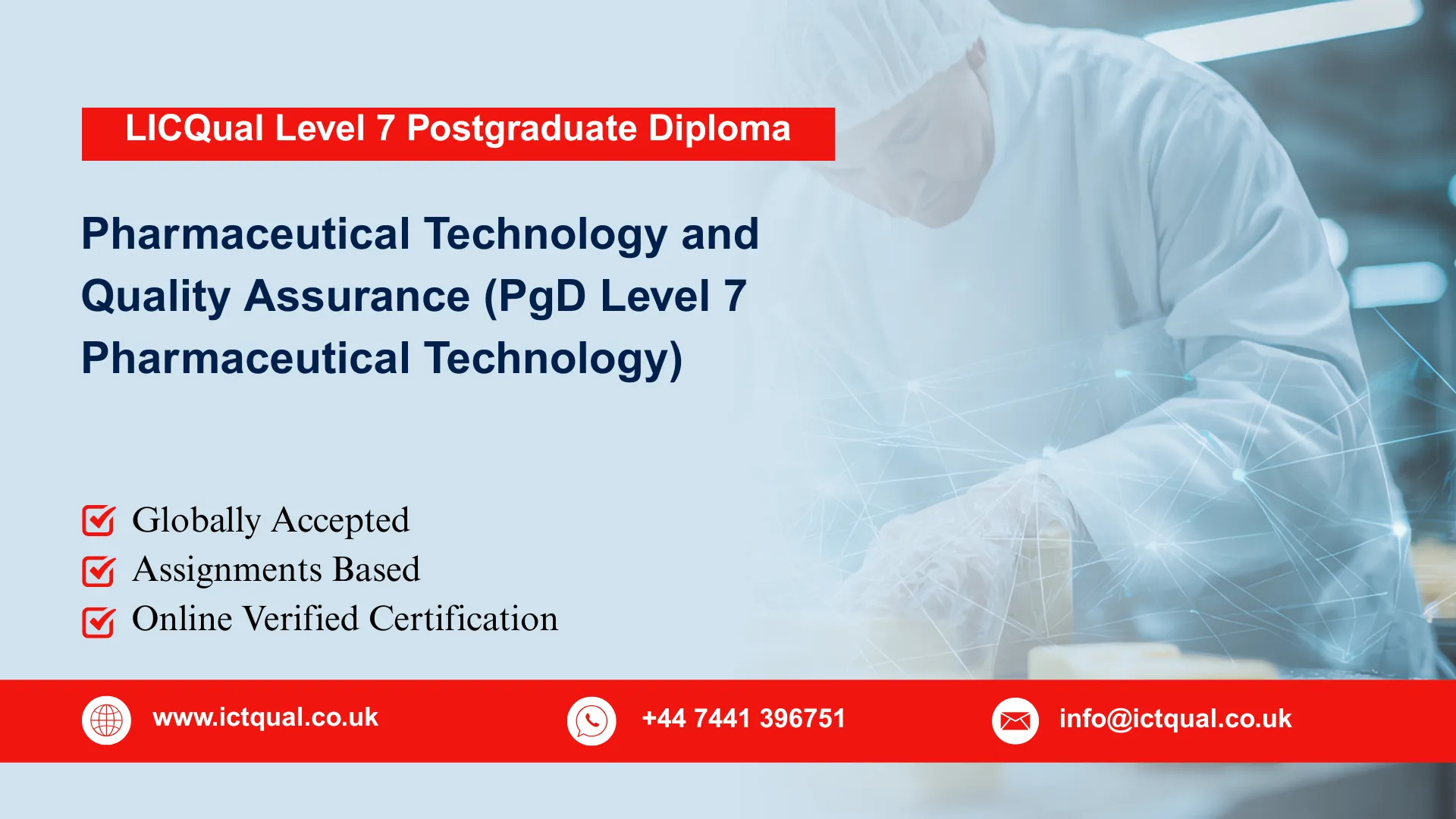
Advanced LICQual Level 7 Pharmaceutical Technology Diploma
Modern healthcare depends on the safe, effective, and reliable production of medicines. Behind every tablet, injection, or capsule lies a complex process that demands precision, innovation, and strict compliance with global standards. Pharmaceutical technology and quality assurance are at the heart of this process, ensuring that medicines are not only effective but also safe for patients worldwide. In an era where regulatory frameworks are tightening and patient expectations are rising, the importance of this discipline cannot be overstated.
The LICQual Level 7 Postgraduate Diploma in Pharmaceutical Technology and Quality Assurance (PgD Level 7 Pharmaceutical Technology) emphasizes the critical role of advanced expertise in this field. Pharmaceutical technology and quality assurance are not just technical concepts—they represent the backbone of trust in healthcare systems. By mastering these areas, professionals contribute to reducing risks, improving patient safety, and driving innovation in drug development. For learners, engaging with pharmaceutical technology and quality assurance is more than academic—it is an opportunity to shape the future of medicine, strengthen professional credibility, and play a pivotal role in advancing global healthcare.
Program Outline
The LICQual Level 7 Postgraduate Diploma in Pharmaceutical Technology and Quality Assurance (PgD Level 7 Pharmaceutical Technology) is a structured qualification designed to provide learners with advanced expertise in pharmaceutical sciences and regulatory compliance. Comprising 6 specialized units and worth 120 credits, the program introduces learners to areas such as drug formulation, manufacturing processes, quality control systems, patient safety frameworks, compliance with international standards, and global best practices in pharmaceutical technology and quality assurance.
This section highlights how the course prepares learners to apply evidence‑based approaches, manage pharmaceutical production effectively, and align with international standards. It outlines the type of learners the program is aimed at, the skills they will gain, and the career pathways available upon completion. Readers will also discover how this internationally recognized qualification opens opportunities in hospitals, pharmaceutical companies, regulatory agencies, and research institutions, making it a valuable credential for anyone aspiring to build a career in pharmaceutical technology and quality assurance.
Unit Structure
| Qualification | Unit Title | Credits | GLH |
| LICQ2201251-1 | Principles of Pharmaceutical Technology | 20 | 100 |
| LICQ2201251-2 | Advanced Manufacturing Processes in Pharmaceuticals | 20 | 100 |
| LICQ2201251-3 | Quality Assurance and Control in Pharmaceutical Practice | 20 | 100 |
| LICQ2201251-4 | Regulatory Affairs and Compliance in Pharmaceuticals | 20 | 100 |
| LICQ2201251-5 | Research, Innovation, and Technology in Pharmaceutical Development | 20 | 100 |
| LICQ2201251-6 | Leadership, Management, and Professional Development in Pharmaceuticals | 20 | 100 |
Who Can Benefit
The LICQual Level 7 Postgraduate Diploma in Pharmaceutical Technology and Quality Assurance (PgD Level 7 Pharmaceutical Technology) is designed for individuals who want to specialize in medicine production, compliance, and patient safety. This program is particularly valuable for those who aim to address challenges such as regulatory adherence, drug formulation accuracy, and quality control. It helps learners strengthen their expertise, improve employability, and prepare for roles where pharmaceutical technology and quality assurance are central to healthcare delivery.
Ideal Learners
- Students aspiring to enter pharmaceutical sciences with a focus on manufacturing.
- Entry‑level professionals seeking structured training in pharmaceutical technology and quality assurance.
- Pharmacy assistants wanting to expand knowledge of production and compliance.
- Community pharmacy staff preparing for responsibilities in medicine safety.
- Hospital pharmacy technicians aiming to strengthen skills in quality control and pharmacology.
- Healthcare professionals transitioning into pharmaceutical technology and quality assurance roles.
- Career changers interested in pharmaceutical innovation and regulatory practice.
- Ambitious learners who want to develop practical skills for pharmaceutical technology and quality assurance careers.
What You’ll Be Able to Do
Unit 1: Principles of Pharmaceutical Technology
Learners will be able to
- Critically analyse the fundamentals of drug formulation, dosage forms, and delivery systems
- Apply knowledge of pharmaceutical materials and excipients to optimise formulations
- Evaluate strategies for developing and improving pharmaceutical products
- Develop solutions to enhance the stability, efficacy, and safety of medicines
Unit 2: Advanced Manufacturing Processes in Pharmaceuticals
Learners will be able to
- Analyse modern manufacturing techniques and process optimisation strategies
- Apply Good Manufacturing Practices (GMP) in pharmaceutical production
- Evaluate production workflows to improve efficiency, quality, and compliance
- Implement strategies for scaling up laboratory formulations to industrial production
Unit 3: Quality Assurance and Control in Pharmaceutical Practice
Learners will be able to
- Design and implement robust quality management systems for pharmaceutical products
- Apply quality control testing methods to ensure product safety and efficacy
- Evaluate risk management and validation processes in manufacturing environments
- Develop continuous improvement strategies to enhance QA/QC procedures
Unit 4: Regulatory Affairs and Compliance in Pharmaceuticals
Learners will be able to
- Interpret global regulatory frameworks and industry standards for pharmaceuticals
- Apply compliance strategies to meet legal, ethical, and safety requirements
- Evaluate documentation, audits, and licensing processes to ensure adherence
- Develop procedures to maintain regulatory compliance throughout the product lifecycle
Unit 5: Research, Innovation, and Technology in Pharmaceutical Development
Learners will be able to
- Plan, conduct, and evaluate research projects in pharmaceutical sciences
- Analyse data and interpret results to inform product development and innovation
- Apply emerging technologies to enhance pharmaceutical processes and product quality
- Integrate evidence-based research into practical pharmaceutical applications
Unit 6: Leadership, Management, and Professional Development in Pharmaceuticals
Learners will be able to
- Apply leadership principles and strategic decision-making in pharmaceutical settings
- Manage projects, teams, and resources effectively to achieve organisational objectives
- Evaluate ethical, professional, and operational challenges in the pharmaceutical industry
- Develop professional growth strategies and lead initiatives to enhance organisational performance