
QA/QC System Process Flow Development Guide
Introduction
Welcome to this critical phase of your professional development within the engineering sector. As a practitioner operating at a senior competency level, understanding the intricate architecture of process workflows within an established framework is not just a theoretical exercise; it is an absolute site necessity. This document serves as your definitive guide to translating overarching quality management principles into tangible, actionable, and highly specific engineering workflows. In our industry, particularly when dealing with complex structural builds or vital infrastructure projects, the margin for error is non-existent. You are expected to demonstrate advanced professional judgment, navigating complicated project requirements while maintaining absolute compliance with stringent statutory obligations. This guide will walk you through the vocational realities of quality control and assurance on active sites, preparing you to document, map, and implement robust systems that can withstand intense regulatory scrutiny. Your ability to map out these complex sequences accurately reflects your core competency in managing high-stakes environments. We do not deal in assumptions; we deal in verifiable facts, controlled processes, and definitive hold points. Mastering this task will prove your capability to lead site quality teams, mitigate severe operational risks, and ensure that every phase of construction or engineering delivery aligns perfectly with the approved design specifications and legal mandates.
Purpose of Assignment
- To assess your capability in translating abstract quality requirements into tangible, step-by-step engineering workflows.
- To validate your professional judgment in identifying and implementing critical control points within a specific engineering procedure.
- To ensure you can independently construct a comprehensive process sequence that aligns seamlessly with strict UK legislative frameworks.
- To confirm your competence in embedding continuous improvement mechanisms directly into procedural documentation to prevent recurring defects.
- To demonstrate your readiness to take full accountability for quality assurance outcomes on complex engineering sites.
- To evaluate your ability to clearly communicate multi-disciplinary tasks to site operatives without creating ambiguity or operational confusion.
- To verify your skill in designing workflows that actively support the golden thread of information required for structural safety compliance.
Concept Explainer Sheet
In high-level engineering QA/QC, a process flow is far more than a simple drawing; it is a legally binding sequence of events that guarantees structural integrity and operational safety across the lifespan of a project. When we map a process, such as structural steel welding inspection or concrete pour approvals, we are establishing the very baseline for all subsequent quality audits and regulatory checks. This explainer breaks down the fundamental components you must master to execute this successfully on site. You must approach this with a mindset focused on risk mitigation and absolute procedural clarity.
- Process Inputs: These are the raw materials, preliminary inspections, or prerequisite documents required before any task can commence under UK compliance frameworks. Identifying these accurately prevents premature work execution.
- Decision Gates: Critical junctures where a senior engineer must apply professional judgment to either approve the continuation of work or halt operations due to identified non-conformances.
- Corrective Loops: Pre-planned, standardized pathways that dictate the exact steps to be taken when a defect is identified, ensuring immediate rectification without compromising the overall project timeline or structural safety.
- Verifiable Outputs: The final, documented evidence that the procedure was executed flawlessly, serving as your primary defense during regulatory audits or final client handover inspections.
Quality Management Systems
Navigating a Quality Management System in the UK engineering landscape requires a profound comprehension of its architecture and its direct interaction with daily site operations. A robust QMS acts as the central nervous system of any engineering project, dictating precisely how quality is planned, executed, and verified at every single stage of the lifecycle. At a Level 6 competency, you must look well beyond mere administrative compliance and understand deeply how a QMS integrates with critical legislation, specifically the Construction (Design and Management) Regulations and the overarching Health and Safety at Work Act. It is fundamentally about fostering a site-wide culture where every operative, from the ground worker to the project director, understands their specific role in the quality chain. When you implement a QMS, you are establishing the operational rhythm of the site itself. This involves interpreting highly complex contractual requirements and distilling them into practical, enforceable site protocols that protect the workforce and the public. Your professional mandate is to ensure that the system is never viewed as a bureaucratic burden, but rather as a streamlined engine that drives efficiency, mitigates severe risk, and guarantees that the final engineered product meets the exact specifications demanded by the client and statutory regulatory bodies.
International Quality Standards
- Complete alignment of site-specific processes with the stringent demands and clauses of ISO 9001 requirements.
- Integration of rigorous document control mechanisms to ensure only the latest, approved construction drawings and specifications are utilized on site.
- Establishment of clear, unbroken traceability protocols for all construction materials, from factory origin to the final installation location.
- Deployment of systematic, unbiased audit schedules to proactively identify and eliminate deviations from established international standards.
- Implementation of standardized non-conformance reporting structures that mandate immediate root cause analysis and definitive preventative actions.
- Ensuring total transparency in supply chain management to verify that all external contractors adhere to the same rigorous international quality expectations.
- Continual assessment of resource allocation to ensure quality assurance teams have the necessary tools to uphold global standards on a local site.
Continuous Improvement Strategies
The absolute hallmark of a seasoned QA/QC professional is the relentless pursuit of operational excellence through the proactive application of continuous improvement. We do not wait for structural failures or audit non-conformances to occur; we actively seek out inefficiencies, vulnerabilities, and potential risks within our established workflows. Utilizing structured methodologies allows us to systematically test new approaches, rigorously measure their impact on site, and standardize the successes across the entire organization. This proactive, analytical stance is exactly what separates competent engineers from true industry leaders who shape safer construction environments.
- Data-Driven Analysis: Utilizing defect frequency rates, material wastage logs, and audit findings to pinpoint specific areas requiring immediate procedural enhancement.
- Stakeholder Engagement: Actively soliciting vital feedback from frontline site operatives and subcontractors to identify practical, ground-level barriers to quality execution.
- Iterative Refinement: Making calculated, incremental adjustments to existing workflows rather than disruptive, sudden overhauls, ensuring smooth transitions and maintained safety.
- Knowledge Dissemination: Ensuring that critical lessons learned from one project phase are rapidly formalized into the QMS and communicated effectively to all active site teams.
Evaluating Performance Measurement
Effective evaluation of a QMS relies entirely on the caliber and relevance of the metrics you choose to monitor on a daily basis. In complex engineering environments, superficial data provides a dangerous false sense of security. You must develop, implement, and rigorously track metrics that offer deep, actionable insights into the actual health of your quality systems. This involves analyzing long-term trends in material degradation, tracking the precise resolution speed of critical non-conformance reports, and evaluating the true effectiveness of corrective actions over extended periods. Your professional judgment is absolutely critical here; you must be capable of looking at a complex matrix of raw site data, identifying the underlying operational narrative, and making decisive, authoritative interventions to correct negative trajectories long before they impact the critical path of the project or compromise the Building Safety Act requirements. This high level of evaluation requires a holistic, cross-disciplinary understanding of how various engineering trades intersect, influence one another, and ultimately dictate the overall project quality outcome.
Process Flow Construction
Show where statutory documentation must be archived for the golden thread.
- Define Process Scope:
- Identify the exact starting trigger of the engineering activity.
- Determine the final, acceptable completion state of the activity.
- Establish strict boundaries to prevent operational scope creep.
- Map Sequential Actions:
- List every distinct physical and administrative step required.
- Ensure chronological accuracy based on UK engineering best practices.
- Assign specific job roles to each individual action step.
- Establish Decision Gates:
- Insert critical inspection hold points (e.g., pre-pour concrete checks).
- Define the exact criteria required to pass the gate.
- Specify who holds the ultimate authority to sign off on the gate.
- Integrate Corrective Pathways:
- Detail the immediate actions required if a step fails inspection.
- Map the route for raising a non-conformance report.
- Illustrate the workflow for rework and subsequent re-inspection.
- Embed Regulatory Compliance:
- Highlight steps directly mandated by the CDM Regulations.
- Indicate where mandatory safety permits must be approved.
- Show where statutory documentation must be archived for the golden thread.
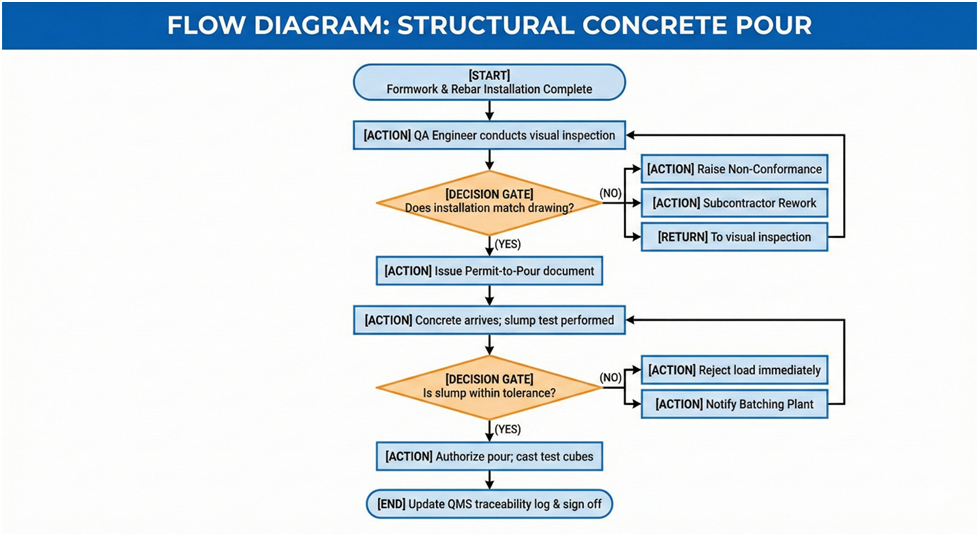
Learner Task Requirements
For this specific practical assessment, you are required to act in the capacity of a lead quality professional responsible for documenting site procedures. You must rely solely on your organization’s formally Implemented QMS documentation as the single piece of evidence to complete this task. Do not draw upon audit plans, performance reviews, or external manuals; your entire response must be grounded in the live, implemented procedural documentation currently governing your engineering environment. Your objective is to dissect a complex process mandated by your QMS and construct a highly detailed, legally sound flow diagram that visually represents this procedure from initiation to final sign-off. This task is a direct test of your ability to synthesize dense written protocols into clear, operational directives that ensure total compliance and structural safety on site.
- Select one critical engineering process documented within your Implemented QMS documentation (e.g., structural steel bolt torqueing sequence, permit-to-work authorization, or deep excavation sign-off).
- Develop a comprehensive, professional-grade flow diagram mapping every single chronological step of this chosen process.
- Ensure your diagram explicitly highlights all mandatory QA/QC hold points and decision gates requiring senior engineering sign-off.
- Embed specific references to relevant UK legislation (such as the CDM Regulations or the Building Safety Act) directly within the applicable steps of your mapped workflow.
- Demonstrate clear, unambiguous pathways for corrective actions and rework in the event of a quality failure during the process execution.
- Clearly designate the specific professional roles responsible for actioning, inspecting, and approving each stage of the sequence.
Submission Guidelines Details
Presenting your work correctly is a fundamental and non-negotiable aspect of professional engineering communication at this level. Your submission must reflect the meticulous, rigorous standards expected in senior QA/QC roles across the UK construction and engineering sectors. Ensure all documentation is robust, clearly indexed, and securely formatted to prevent any unauthorized alterations once submitted. The completed process flow diagram must be submitted as a high-resolution, clear digital file, ensuring that all text, decision gates, and regulatory references are entirely legible. You must strictly title the document with your full candidate registration details, the current date, and the exact name of the engineering process you have mapped. It is imperative that your work relies exclusively on the single requested evidence type—Implemented QMS documentation—as utilizing multiple evidence types for this specific task will result in an over-assessment penalty. The workflow you submit must not be a theoretical exercise; it must be a true, accurate reflection of actual, implementable site practices that demonstrates your advanced competency, your understanding of objective-based vocational tasks, and your highly developed professional judgment.