
Photo Interpretation in Health & Social Care Leadership
Introduction
Photo / Diagram Interpretation plays a crucial role in the advanced management of health and social care, where an operational plan is only as effective as the physical and environmental realities that shape it. For a Level 5 leader, the ability to “read” a service environment—spotting hidden hazards, non-compliances, workflow barriers, and risks—is essential to informed decision-making. Through structured visual analysis, Photo / Diagram Interpretation becomes a diagnostic tool that reveals where operational plans are breaking down and highlights the areas where the “Need for Change” is most urgent.
Operational planning requires a keen eye for detail. When you develop a plan to, for instance, increase the independence of service users in a residential unit, you must first interpret the physical environment through diagrams and site images to ensure that the proposed changes are safe and feasible. If a technical diagram of a floor plan shows a fire exit blocked by a new storage solution, your operational plan is fundamentally flawed. This unit focuses on transforming these visual observations into Contingency Planning Documentation.
Leading change also involves “Visual Advocacy.” To gain support for a proposed change—such as a budget request for environmental modifications—you must be able to present visual evidence of non-compliance or hazard. By interpreting diagrams of current workflows or site photos of inadequate facilities, you facilitate a shared understanding among stakeholders (including inspectors and trustees) regarding why the status quo is no longer an option. This task will challenge you to move beyond the verbal and into the visual, ensuring that your implementation strategies are grounded in the tangible reality of your area of responsibility.
1. Visual Diagnostics and the Principles of Change Management
Identifying the Visible Need for Change
The first principle of change management is establishing urgency. In a vocational setting, this often comes from a “Visual Audit.” By interpreting site images that show wear and tear, overcrowding, or unsafe working practices, a manager can provide an undeniable rationale for change. This visual evidence acts as the “Driver,” moving the operational plan from a theoretical idea to a mandatory safety requirement.
Facilitating Understanding through Spatial Awareness
When staffs are resistant to change, it is often because they cannot visualize the benefit. Using technical diagrams to show a “Before and After” state of a department can help in facilitating a shared understanding. If a manager can demonstrate via a diagram how a new room layout reduces the physical strain of manual handling, the staff are much more likely to support the implementation of the new operational plan.
2. Developing Approved Plans and Contingency Documentation
Incorporating Technical Diagrams into Operational Design
An “Approved Plan” must be technically sound. This involves reviewing floor plans, fire escape routes, and equipment placement diagrams. As a Level 5 leader, you must ensure that your operational objectives do not contradict the physical constraints of the building. This phase of planning involves “Environmental Risk Mapping,” where you use site photos to identify potential “Fail Points” in your plan before it is even launched.
The Role of Contingency Planning in Operations
Contingency planning is the “What If” of management. It involves preparing for the failure of the primary operational plan. For example, if your plan relies on a new digital call system, your Contingency Planning Documentation must include a diagram of the manual backup system. Visualizing these contingencies through flowcharts or site-specific maps ensures that when a crisis occurs, the response is immediate and coordinated.
3. Implementation and Visual Evaluation of Compliance
Monitoring Implementation through Site Inspection
During the implementation of an operational plan, the manager must conduct regular site inspections. This involves comparing the actual workplace (via site images) against the “Model State” defined in the plan. Any deviation—such as a “Non-Compliance” in equipment storage—must be corrected immediately. This visual monitoring ensures that the implementation stays on track and meets regulatory expectations.
Evaluating the Environmental Impact of Change
The final evaluation of a change management process should include a visual review. Did the operational plan lead to a safer, more efficient environment? By comparing “Baseline Photos” from the start of the project with “Post-Implementation Photos,” you provide tangible evidence of success. This form of evaluation is highly valued by regulatory bodies like the CQC, as it provides “Observable Evidence” of leadership and service improvement.
Learner Task:
Required Evidence: Contingency planning documentation
The Scenario: The “Pathway A” Expansion Project
You are the Registered Manager of a specialized Children’s Residential Home. To meet an Organizational Goal of increasing capacity, you have developed an Operational Plan to convert a large, underutilized communal “Activity Room” into two high-dependency bedrooms.
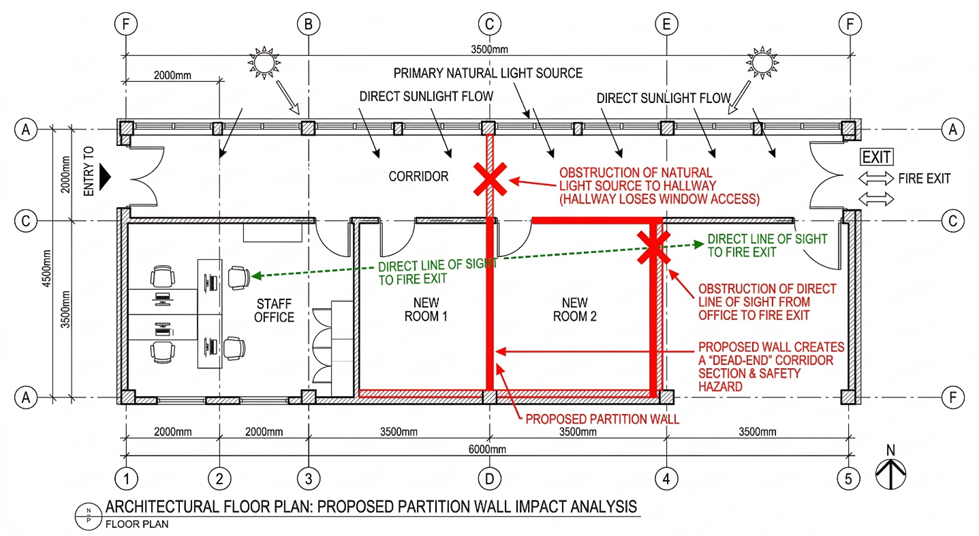
However, during a site inspection, you are presented with the following Technical Diagram (represented here by description) and Site Image observations:
- Technical Diagram Observation: The architectural drawing shows that the proposed partition wall for the two new rooms will cut off the primary natural light source for the hallway and obstruct the direct line of sight from the staff office to the fire exit.
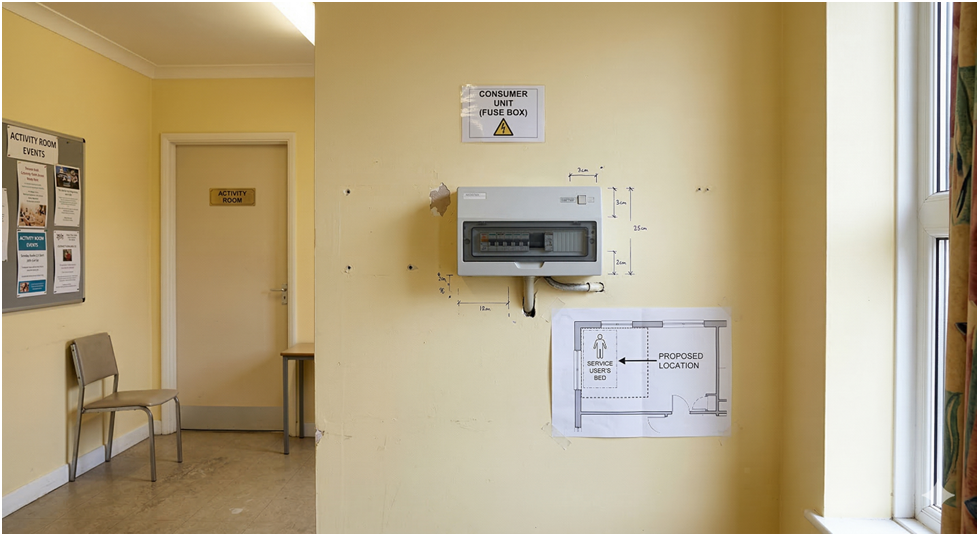
- Site Image Observation: A photo of the “Activity Room” shows that the current electrical “Consumer Unit” (fuse box) for the entire floor is located on the wall exactly where a service user’s bed is planned to be placed.
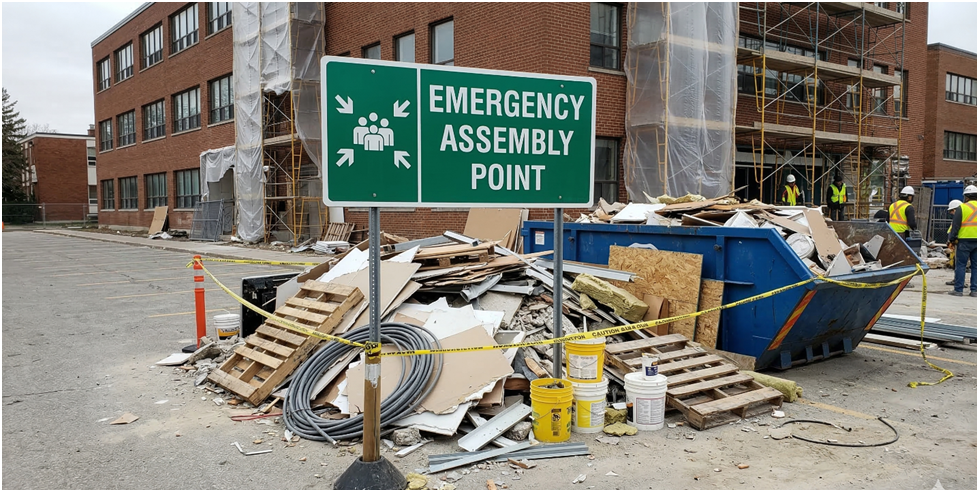
- Site Image Observation: The external photo shows that the “Emergency Assembly Point” is currently being used for construction waste storage for the renovation.
Task Objectives
- To interpret non-compliances and hazards from technical and visual data.
- To adjust an operational plan based on visual evidence.
- To develop robust Contingency Planning Documentation for the transition phase.
- To facilitate a shared understanding of the risks with the construction team and staff.
Task Questions
1. Interpretation of Risk: Based on the observations above, identify three specific “Non-Compliances” with health and safety regulations. Explain how these visual findings impact your original operational plan for the room conversion.
2. Facilitating Understanding: You must meet with the “Head of Maintenance” and the “Staff Team” who are excited about the expansion. How will you use these diagrams/photos to explain why the implementation must be paused or changed? How do you ensure they understand the safety implications?
3. Developing the Contingency Plan (Required Evidence): You are required to produce Contingency Planning Documentation for the “Construction Phase.” This document must outline:
- What will happen if the fire exit is obstructed during the build?
- What is the “Plan B” for the assembly point?
- How will you manage the risk of the exposed electrical unit during the transition?
4. Gaining Support for Adjustments: Because of these visual findings, you need an extra 10,000 Pounds for electrical re-routing. How will you present this visual evidence to the Board of Directors to gain support for this budget increase?
5. Evaluation: Once the rooms are completed, how will you use “Photo Evidence” in your final evaluation report to prove that the new operational environment is safe and meets the original objectives of the expansion?
Expected Outcomes
- Outcome 1: A detailed analysis of environmental hazards based on site-specific visual data.
- Outcome 2: A professional Contingency Plan that addresses fire safety and utility risks.
- Outcome 3: Evidence of a manager who can adapt operational plans in response to technical “Real-Site” feedback.
- Outcome 4: A clear strategy for visual reporting and evaluation.
Learner Task Guidelines & Submission Requirements
- Required Evidence: Your primary submission must be the Contingency planning documentation created in response to the “Pathway A” scenario.
- Vocational Context: Your answers should reflect the high-dependency nature of a children’s residential setting. Use terminology such as “Ofsted Compliance,” “Building Regulations,” and “Health and Safety at Work Act.”
- Format of Contingency Plan: * Use a “Trigger and Action” format (e.g., “If [Risk X] occurs, we will [Action Y]”).
- Include a simple hand-drawn or digitally created “Revised Flowchart” or “Layout Diagram” to show your proposed safety adjustments.
- Detail and Depth: Do not just list the hazards. Explain the Impact of the hazards on the service users and the staff. Level 5 requires “Advanced” analytical thinking regarding the long-term operational viability.
- Submission Standards: * Word count: 2,500 to 3,500 words.
- No external links.
- Mention clearly: “This task provides evidence for the unit ‘Develop and evaluate operational plans’ focusing on Contingency Planning Documentation.”
- Avoid Academic Style: Focus on “Site Inspection Awareness.” Talk like a manager conducting a walkthrough, not a student writing an essay.