
ABMA Level 4 Diploma Guide: Knowledge Application in Community Development (RQF)
Introduction
Effect in communities is a crucial consideration for every Community Development Officer (CDO). They must be able to anticipate the future—or at least predict the consequences of social change. When a policy shifts in London or a global market fluctuates, the ripple effects eventually reach the streets of local neighborhoods.
This task trains you to apply C. Wright Mills’ concept of the “Sociological Imagination”—the ability to connect personal troubles (local issues) with public issues (structural forces). By practicing this skill, you will learn to map the chain reaction from the global and national level down to the local level, revealing how large‑scale decisions and events shape everyday life.
A. Knowledge Guide
1. The Chain Reaction: Macro to Micro
Sociologists analyze society at three levels. To understand a local problem, you must track it through these levels:
- Macro Level (Global/National): Large-scale forces.
- Examples: Global recessions, UK Parliament passing the Welfare Reform Act 2012, Climate Change.
- Meso Level (Institutional/Regional): How institutions react to the Macro changes.
- Examples: Your Local Council cutting budgets to meet national targets, a factory closing down, housing associations changing tenancy rules.
- Micro Level (Local/Individual): The impact on daily life.
- Examples: A family evicted due to rent arrears, a youth club closing, increase in loneliness among the elderly.
The Vocational Rule: A problem on the “Micro” level (e.g., Youth Crime) usually has its start button pressed at the “Macro” level (e.g., Economic Policy).
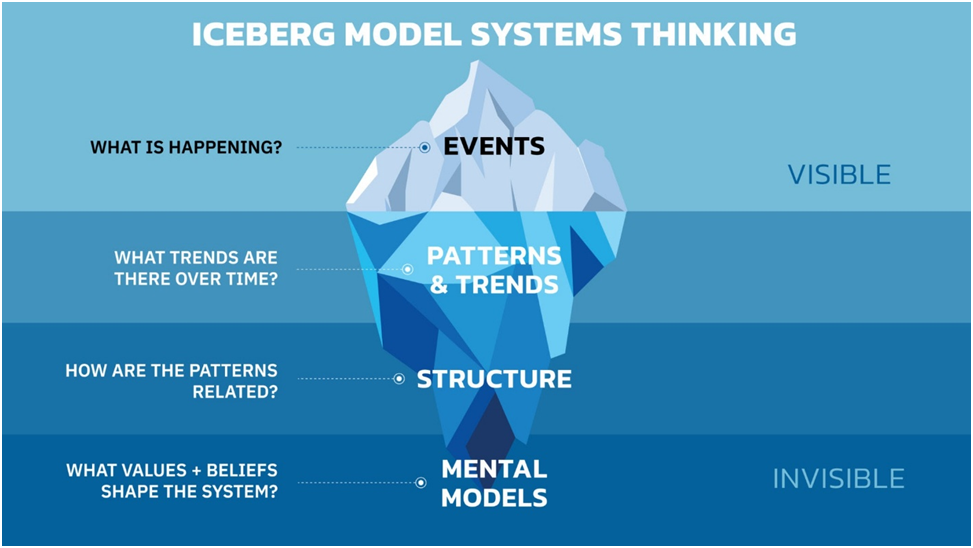
2. Root Cause vs. Symptom (The Iceberg Model)
When assessing a community, you will often see the Symptom first. You must dig deeper to find the Root Cause.
- The Symptom (What you see): High rates of fly-tipping (dumping rubbish) in alleyways.
- The Immediate Cause: People don’t care about their environment (Cultural explanation).
- The Root Cause (Structural): The Council introduced a fee for collecting bulky waste due to budget cuts, and residents on low incomes cannot afford it (Economic/Political explanation).
Why this matters: If you only treat the symptom (clean up the rubbish), it will come back. If you address the root cause (campaign for free collection days), you solve the problem.
3. Consequences: The “Do Nothing” Scenario
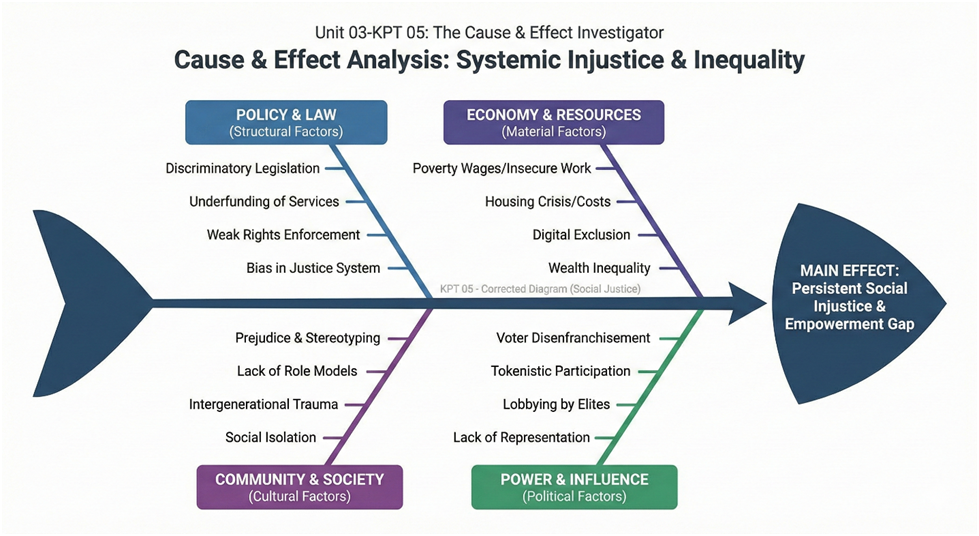
What happens if these root causes are ignored? Sociologist Robert Merton proposed Strain Theory, which is vital for community safety analysis.
- The Theory: When society sets goals (e.g., “Have a nice house and job”) but blocks the means to achieve them (e.g., Poor education, racism, no jobs), it creates “Strain.”
- The Consequence: People react in predictable ways:
- Innovation (Crime): Stealing to achieve the goal.
- Retreatism (Addiction): Dropping out of society (drugs/alcohol).
- Rebellion (Unrest): Rioting or protesting to change the system.
Vocational Application: If a community’s needs are unmet for too long, a CDO should predict an increase in Anti-Social Behavior (ASB) or civil unrest.
B. Learner Task Template
Task 5: The Chain of Events (Impact Mapping)
Instructions:
You are analyzing the impact of the UK Cost of Living Crisis on a fictional deprived neighborhood called “Oakhaven Estate.”
Fill in the missing links in the chain below to show how a National Economic Issue becomes a Local Social Problem. Use the sociological terms provided in the Knowledge Guide.
Scenario A: The “Heat or Eat” Dilemma
| Level of Impact | The Event / Description | Your Analysis |
| Start Event (Macro) | Global Energy Crisis & Inflation. | Prices for gas and electricity rise by 50% across the UK. |
| ⬇️ Step 1 (Impact on Disposable Income) | Household budgets are squeezed. | [Learner to complete] (Explain what happens to the residents’ discretionary spending money.) |
| ⬇️ Step 2 (Impact on Social Participation) | Residents stop attending paid activities. | [Learner to complete] (How does this affect the local Bingo Hall or community café?) |
| ⬇️ Step 3 (Social Consequence) | Isolation increases. | [Learner to complete] (Use the term ‘Social Exclusion’ or ‘Mental Health’ here.) |
| Final Outcome (Micro) | Community Fragmentation. | The local café closes due to lack of customers; elderly residents lose their only social hub. |
Scenario B: The Policy Shift
| Level of Impact | The Event / Description | Your Analysis |
| Start Event (Macro) | The UK Government passes the ‘Localism Act 2011’. | Power is devolved from Central Government to Local Communities. |
| ⬇️ Step 1 (Impact on Opportunity) | Right to Challenge / Right to Bid. | [Learner to complete] (What legal right does this give the community regarding local buildings?) |
| ⬇️ Step 2 (Impact on Agency) | Community Group forms. | [Learner to complete] (Describe the ‘Social Capital’ required here.) |
| Final Outcome (Micro) | Community Ownership. | Residents take over the threatened library and run it as a volunteer hub. |
Learner Task Guideline
- Think Like a System: Do not view these events in isolation. In Scenario A, notice how an Economic factor (inflation) leads to a Social consequence (isolation). This is the core of sociological analysis.
- Use Statutory References: In Scenario B, you are explicitly asked about the Localism Act 2011. Make sure you understand the difference between the “Right to Bid” (buying an asset) and the “Right to Challenge” (taking over a service).
- Assess Consequences: When describing the impact, try to quantify it if possible (e.g., “Reduced footfall,” “Loss of revenue,” “Increase in GP appointments for depression”).
Submission Requirements
- Format: Copy the tables into a Word Document and fill in the blank sections.
- Word Count: Approximately 30–50 words per box.
- Deadline: [Insert Date Here]
- Assessment: This task contributes to evidence for Assessing consequences and Understanding social theory in relation to community.