
Fire Safety Diagram Interpretation for Assessors
1. Introduction to the Task
Introduction to the Photo / Diagram Interpretation Task
Fire risk assessment in the built environment of the United Kingdom, particularly within High-Risk Buildings (HRBs), demands an uncompromising level of scrutiny and professional responsibility. This task is designed to bridge the gap between theoretical knowledge and real-world, on-site competency. In practice, a fire risk assessor is often faced with complex, unclear, or visually ambiguous situations that require immediate and well-informed professional judgment. The focus of this task is the careful interpretation and analysis of visual evidence, encouraging you to look beyond the obvious appearance of a defect and understand its wider impact on the building’s overall fire safety strategy.
When inspecting an HRB, the stakes are exponentially higher due to extended evacuation times, complex vertical fire spread risks, and the reliance on “stay put” strategies. Identifying a flaw in a photograph or diagram is not merely an exercise in observation; it is a fundamental test of your situational awareness and your ability to foresee catastrophic failure modes. You are not just identifying what is wrong; you are diagnosing why it is wrong, assessing the severity of the risk it poses, and determining the immediate and long-term actions required to restore the integrity of the building. This exercise will strictly evaluate your capacity to interpret visual evidence of compartmentation and translate that visual data into actionable, compliant risk management strategies.
Legislative and Regulatory Framework Governing Visual Inspections
- The Regulatory Reform (Fire Safety) Order 2005 (Article 9): Mandates the requirement for a suitable and sufficient fire risk assessment, which inherently includes the visual inspection and evaluation of passive fire protection measures and compartmentation integrity.
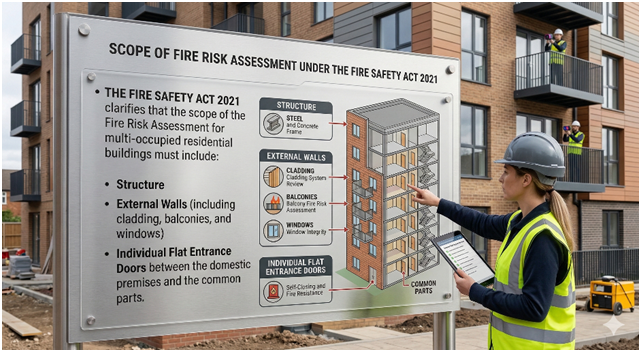
- The Fire Safety Act 2021: Clarifies that the scope of the Fire Risk Assessment for multi-occupied residential buildings must include the structure, external walls (including cladding, balconies, and windows), and individual flat entrance doors between the domestic premises and the common parts.
- The Building Safety Act 2022: Introduces the stringent regime for higher-risk buildings, emphasizing the “Golden Thread” of information. Visual evidence of defects directly challenges the integrity of the safety case report and demands accountable, transparent corrective measures by the Principal Accountable Person (PAP).
- The Fire Safety (England) Regulations 2022: Imposes specific duties regarding the checking of fire doors and the provision of information to residents, making the visual assessment of fire door sets a critical statutory requirement.
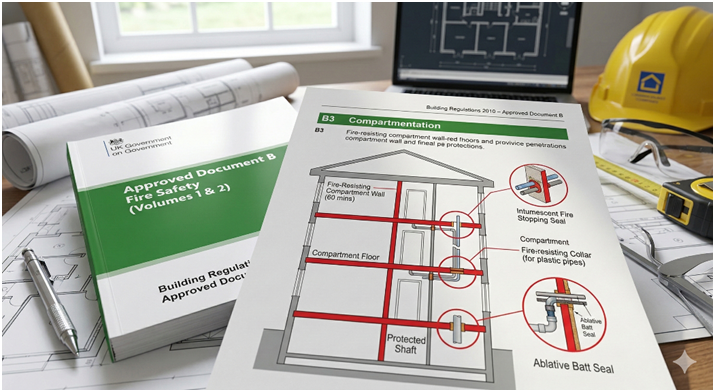
- Building Regulations 2010 (Approved Document B): Provides the baseline statutory guidance for fire safety, specifically detailing the requirements for compartmentation, fire stopping, and the protection of service penetrations (Volumes 1 and 2).
The Principles of Photographic Defect Interpretation in HRBs
Interpreting a photograph of a defect requires a multifaceted approach. A competent assessor does not view a structural anomaly in isolation. When you examine a visual representation of a potential hazard, you must mentally superimpose the building’s fire strategy over the image. If you observe a service penetration through a compartment wall, your first thought must center on the fire resistance rating of that wall. Is it a 60-minute or 120-minute barrier?
Furthermore, you must evaluate the timeline of the intervention. Does the defect appear to be part of the original construction, indicating a systemic failure in the initial build quality, or is it the result of retrospective work by a third-party contractor? This distinction is vital for root cause analysis. Retrospective service installations—such as the routing of new telecommunications cables or upgraded plumbing—are notorious for breaching established compartment lines. Your interpretation must assess not only the physical gap but the materials used in any attempted fire stopping. The visual presence of inappropriate materials, such as standard polyurethane expanding foam instead of certified intumescent acrylics or ablative batts, instantly escalates the risk profile. The interpretation process requires you to constantly ask “what if.” What happens if a fire initiates on the other side of this visual boundary? How quickly will smoke permeate this flaw, and how will that impact the tenability of the primary escape route?
Critical Competency Indicators in Compartmentation Analysis
- Identification of Substrate Compatibility: Recognizing whether the fire-stopping material visually aligns with the substrate it is interacting with (e.g., masonry, plasterboard, concrete).
- Evaluation of Linear Gap Seals: Assessing the visual continuity and depth of seals at the junctions between fire-resisting elements, such as where a concrete floor slab meets an external curtain wall.
- Analysis of Service Penetrations: Scrutinizing the specific treatment of different services—noting if plastic pipes are fitted with appropriate intumescent pipe collars or wraps, and if cable trays are appropriately sealed with ablative coated batts.
- Assessment of Fire Dampers: Identifying the presence, or visual absence, of required fire dampers where ventilation ductwork passes through a recognized compartment wall or floor.
- Detection of Covert Breaches: Utilizing situational awareness to spot signs of hidden breaches, such as dust trails, light bleed, or unusual acoustic transmission, which may be captured or suggested in site imagery.
Complex Decision Making and Situational Awareness
The true test of a senior-level assessor lies in the actions taken immediately following the identification of a severe defect. When reviewing photographic evidence that reveals a catastrophic failure in compartmentation—such as a completely unsealed service riser bridging multiple floors of a residential tower—you must rapidly transition from observation to crisis management. This is where situational awareness shifts from passive observation to active intervention.
You must contextualize the visual finding against the building’s occupancy profile. A compartmentation breach in a high-risk building housing vulnerable or mobility-impaired residents fundamentally alters the risk matrix. If the visual evidence proves that the “stay put” policy is fundamentally compromised because fire and smoke can bypass compartment floors unchecked, you face a complex decision. Does this visual evidence warrant the implementation of an immediate action plan? Do you need to advise the Responsible Person to initiate a waking watch or consider partial evacuation? The interpretation of a single photograph can therefore trigger a cascade of critical life-safety protocols. Your judgment must be decisive, grounded purely in objective evidence, and resilient against commercial pressures to downplay the severity of the findings.
LEARNER TASK: Compartmentation Review (Photographic Evidence)
Evidence Requirement Focus: This task strictly utilizes ONE piece of evidence from the assessment plan: Photographic evidence of: Compartmentation review.
Contextual Scenario for the Evidence:
You are undertaking a Fire Risk Assessment of a purpose-built, 15-storey residential block of flats (a designated High-Risk Building). The building operates a “stay put” evacuation strategy. During your inspection of the common areas, you access a locked electrical service riser cupboard located on the 8th floor, adjacent to the single protected staircase.
The Visual Evidence (Task Dossier Description):
You are presented with a detailed, high-resolution photograph taken looking vertically down through the floor slab inside the 8th-floor electrical riser. The photograph clearly shows the following distinct visual data points:
- A large square opening in the concrete floor slab, approximately 600mm x 600mm.
- Multiple heavy-duty PVC electrical cable trays and a 100mm un-insulated PVC soil/vent pipe passing vertically through the opening down to the 7th floor.
- The gap between the services and the concrete slab has been partially filled with a highly expanded, bright pink foam.
- The pink foam is brittle, visibly charred in one corner (likely from a previous hot-works operation), and has large, visible voids where light from the 7th floor is clearly shining through into the 8th-floor riser.
- There are no intumescent collars visible around the 100mm PVC pipe.
- There are no ablative batts or certified load-bearing fire seals present.
Your Instructions:
Based entirely on your interpretation of the described photographic evidence of this compartmentation review, you must draft a formal, professional evaluation addressing the following critical elements:
- Defect Diagnosis: Provide a highly technical breakdown of every compliance failure visible in the scenario. Detail why the current materials (e.g., the pink foam) are categorically unacceptable in this specific high-risk application.
- Legislative Breach Identification: Identify the specific UK fire safety legislation and building regulations (including specific Approved Document B clauses regarding service penetrations) that are currently being breached by the conditions shown in the evidence.
- Risk Escalation and Strategy Impact: Critically evaluate how this specific visual evidence impacts the building’s overall “stay put” strategy. Explain the physical mechanics of how smoke and fire would behave given this specific defect, considering the location adjacent to the primary escape route.
- Immediate Action Plan (Intolerable Risk): Determine if this visual evidence constitutes an intolerable risk. Formulate the precise, immediate, short-term advice you would issue to the Principal Accountable Person before leaving the site.
- Long-Term Remediation Specification: Outline the exact technical remediation requirements. Specify the correct, certified passive fire protection materials and installation methods required to legally and safely reinstate the compartment floor slab to a minimum of 120 minutes fire resistance.
Submission Guidelines
| Requirement | Detail |
| Format | Formal professional technical report format. Use clear headings, professional terminology, and structured arguments. |
| Length | Comprehensive enough to cover all technical aspects of the visual evidence. Expected depth should reflect Level 5 competency. |
| Evidence Linkage | Your entire response must be anchored only to the provided Photographic evidence of: Compartmentation review. Do not introduce theoretical defects not present in the scenario. |
| Justification | Every recommended action must be explicitly justified by citing UK legislation or recognized industry standards (e.g., ASFP Blue Book guidelines for fire stopping). |
| Professional Tone | The submission must reflect the gravitas and absolute precision expected of an advanced practitioner advising a corporate client on severe life-safety defects. |