
ABMA Level 4 Diploma Guide: Evaluating Community Impact (RQF)
Introduction
In the past, community work was often judged on “good intentions.” Today, under UK frameworks like the Public Services (Social Value) Act 2012, professionals must prove their Impact.
This task teaches you how to act as an Auditor of Social Change. You will learn to distinguish between a project that looks good on paper (Output) and a project that actually changes lives (Outcome). You will also learn the sociological difference between a temporary “relief” intervention and true “sustainable development.”
A. Knowledge Guide
1. Success Indicators: Measuring the Invisible
Sociology provides two distinct ways to measure truth. A competent Community Development Officer (CDO) uses both to build a “Mixed Methods” evaluation.
| Indicator Type | Sociological Basis | Vocational Example |
| Quantitative Data (Hard Data) | Positivism: Believes society can be measured scientifically with numbers. | • “Unemployment dropped by 15%.” • “Attendance increased to 200 people.” • “£10,000 was raised.” |
| Qualitative Data (Soft Data) | Interactionism/Interpretivism: Believes truth is found in people’s meanings and stories (Verstehen). | • “I feel more confident now.” (Case Study) • “This place feels like home.” (Focus Group quote) • “I trust my neighbours more.” (Social Capital). |
The Vocational Trap: Don’t rely only on numbers. A youth club might have high attendance (Good Quantitative) but the teenagers are bullying each other inside (Bad Qualitative).
2. Sustainability: Beyond “Green”
In community development, sustainability doesn’t just mean “Eco-friendly.” It refers to the Longevity of a project. We analyze this using the Three Pillars of Sustainability.
- Financial Sustainability: Can the project survive after the initial grant ends?
- Unsustainable: “We rely 100% on a Council grant.”
- Red Flag: “I didn’t bother consulting them because it would take too long and I know what they need.”
- Unsustainable: “We rely 100% on a Council grant.”
- Social Sustainability (Institutional): Does the community “own” the project?
- Unsustainable: If the paid worker leaves, the project collapses (Dependency).
- Sustainable: Local volunteers run the committee; the project survives even if the worker leaves (Empowerment).
- Unsustainable: If the paid worker leaves, the project collapses (Dependency).
- Environmental Sustainability: Does it harm the local area?
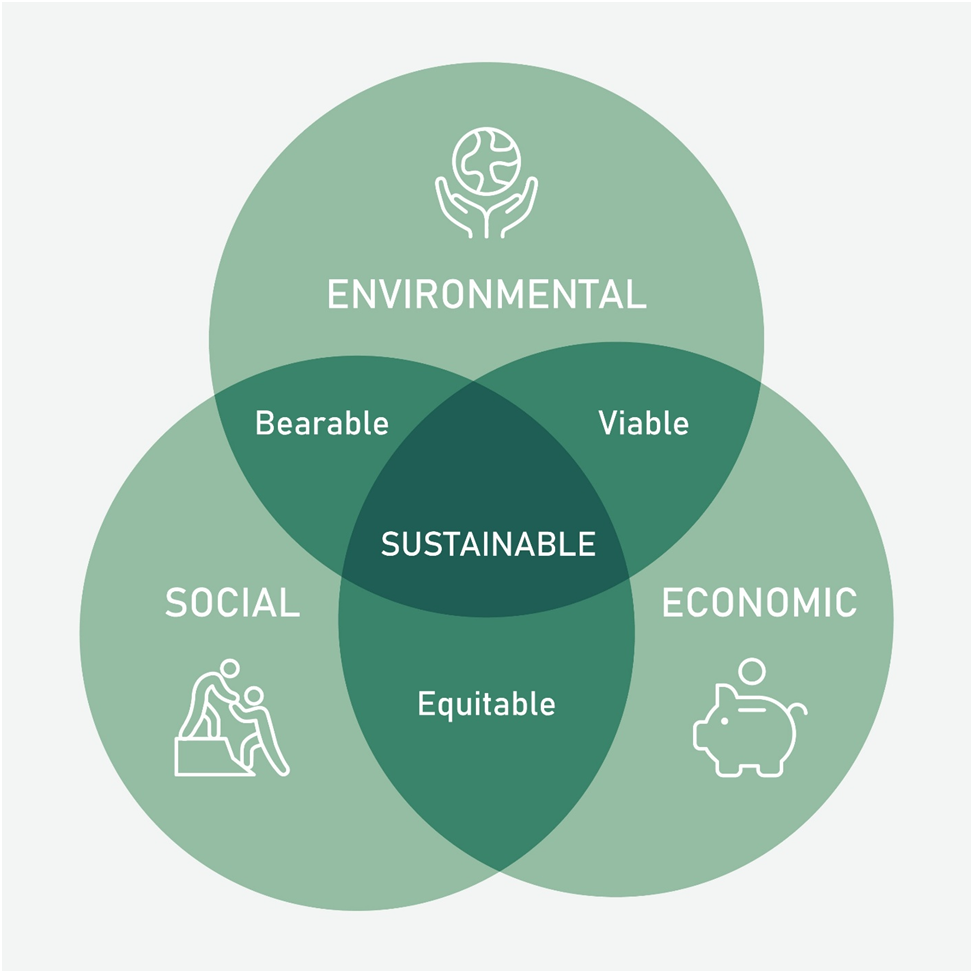
3. Evaluation Questions: The Logic Model
When auditing a project, use the Input -> Output -> Outcome logic chain to ask the right questions.
- Did we deliver what we promised? (Output Review)
- Question: “We said we’d run 10 sessions. Did we run 10?”
- Did it meet the need? (Relevance)
- Question: “We ran a CV workshop, but the residents actually needed mental health support. Was this a waste of time?”
- Was it cost-effective? (Value for Money)
- Question: “We spent £50,000 to help 2 people. Could we have helped 50 people with that money?”
- Were stakeholders happy? (Accountability)
- Question: “Do the residents feel heard, or do they feel the project was done to them?”
B. Learner Task Template
Task 8: Project Evaluation
Instructions:
You are acting as an external evaluator. Review the Project Summary below for a fictional project in a UK city.
Using the sociological concepts of Sustainability and Social Capital, rate the project’s long-term success and write a reasoning paragraph.
Project Summary: “The Digital Kiosk Initiative”
The Plan: To combat the “Digital Divide” in a low-income estate, the Council received a one-off central government grant of £100,000.
The Action: They installed five high-tech, solar-powered internet kiosks in the local park. No local residents were consulted on the design or location because the funding deadline was tight (Top-Down approach).
The Result (1 Year Later):
- Usage: High usage for the first month.
- Current State: Three kiosks have been vandalized and are broken. The other two are used exclusively by drug dealers to arrange transactions via encrypted apps.
- Maintenance: The Council has no budget left to repair the screens.
- Community View: Residents describe the kiosks as “eyesores” and “magnets for trouble.”
Your Evaluation:
- Sustainability Score (1–10):
- (1 = Total Failure / 10 = Perfectly Sustainable)
- Score: ______ / 10
- (1 = Total Failure / 10 = Perfectly Sustainable)
- Reasoning (The Impact Analysis):
In your paragraph, explain WHY the project failed. Use the following prompts:
- Was this an Asset-Based or Deficit-Based approach?
- Why did the lack of consultation (Socialisation) lead to vandalism (Lack of Ownership)?
- Why is this financially unsustainable?
[Learner types evaluation here]
Example starter: “I have given this project a low score because it represents a classic ‘Top-Down’ failure. Although the intent was to address the Digital Divide (Ideology of inclusion), the Council failed to build Social Capital…”
Learner Task Guideline
- Identify the “White Elephant”: In vocational terms, a project that is expensive to build but useless to maintain is called a “White Elephant.” This scenario is a perfect example.
- Connect Ownership to Safety: Sociologically, vandalism often happens when a community feels no ownership over an object. If the residents had built the kiosks themselves, they would likely protect them (Agency). The vandalism here is a form of Rejection of an imposed solution.
- Financial Reality: Note that “Capital Funding” (money to build) is different from “Revenue Funding” (money to run/repair). A common mistake in community work is getting the former without the latter.
Submission Requirements
- Format: Text response in the template provided.
- Length: 100–150 words for the reasoning paragraph.
- Assessment: Evidence for Evaluate effectiveness and Sustainability.