
ABMA Level 4 Diploma Guide: Community Development (RQF)
Introduction
Strong and inclusive community development is never a solo effort. It involves a complex web of people, organizations, and authorities, often with conflicting agendas. A core competency for a Community Development Officer (CDO) is the ability to “code‑switch”—to understand the world through the eyes of a frustrated resident, a budget‑conscious councilor, or a profit‑driven investor.
This task uses sociological concepts to help you map these perspectives. You will learn to identify not just who is involved, but why they act the way they do based on their ideology, socialisation, and identity.
A. Knowledge Guide
1. The Players: A Vocational “Who’s Who”
In UK community development, you will typically encounter these four archetypes. Understanding their sociological role is key to engagement.
| Stakeholder Group | Sociological Role | Typical “Ideology” |
| The Residents | The Lifeworld: The people who live the experience. They are the experts on the “felt needs” of the area. | Communitarianism: “We need to look after our own.” Focus on safety, belonging, and stability. |
| The Local Authority (Council) | The Bureaucracy: They hold the statutory power and funding. They are bound by UK Law (e.g., Local Government Act). | Managerialism / Neoliberalism: “We must deliver value for money and efficiency.” Focus on targets and budgets. |
| Private Developers / Investors | The Market: External agents bringing capital but often causing gentrification. | Capitalism: “We need a Return on Investment (ROI).” Focus on profit and property value. |
| Third Sector (Charities/NGOs) | The Mediator: Organizations bridging the gap between state and people. | Social Justice: “We must support the vulnerable.” Focus on equity and rights. |
2. Motivations: The Power & Interest Matrix
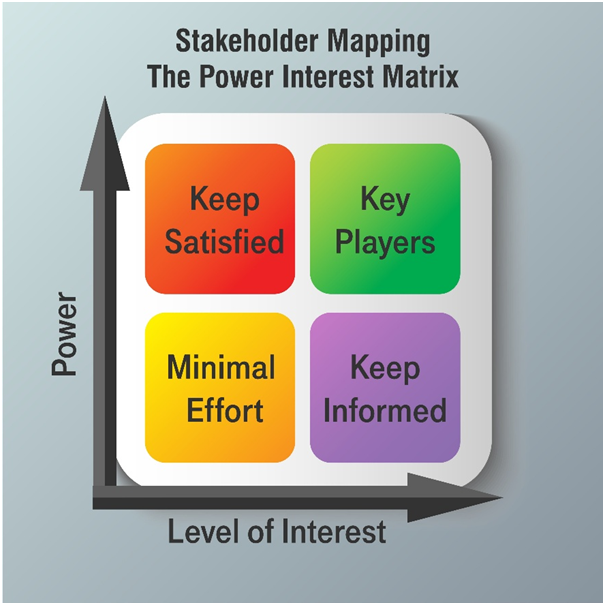
To manage these groups, you must analyze their motivations. We use Mendelow’s Matrix to map stakeholders based on:
- Power: How much influence do they have to stop or start a project?
- Interest: How much do they care about the outcome?
- High Power / High Interest (Key Players): usually the Council or Major Funders. You must Manage Closely.
- Low Power / High Interest (The Community): Often the residents. They care deeply but lack structural power. Your job as a CDO is to Empower them (move them up the power axis).
3. Diversity & Identity: The “Intersectionality” Lens
A community is not a monolith. “The Residents” are not all the same. Their reaction to a community issue is filtered through their Identity and Socialisation.
You must apply the UK Equality Act 2010 and the concept of Intersectionality (how different identities overlap) to understand their specific needs.
- Age (Generational Theory):
- Elderly: May value tradition and face Digital Exclusion (struggling with online-only council services).
- Youth: May value social spaces and face Labelling (being unfairly seen as “trouble” by police).
- Culture & Ethnicity:
- Different cultural groups have different norms regarding family structure and public space. Ignoring this leads to Cultural Blindness in service design.
- Disability:
- Under the Social Model of Disability, the barrier is not the person’s condition, but the environment (e.g., a community hall with steps but no ramp).
B. Learner Task Template
Task 3: In Their Shoes
Instructions:
Read the scenario below carefully. It represents a common conflict in UK urban planning. You will be assigned two distinct personas. You must write a response (3–4 sentences) from the perspective of that specific person, using the “I” voice.
The Scenario: “The Digital-First Hub” “The Local Council has announced it is closing the old physical Community Centre, which is expensive to heat and maintain. In its place, they are launching a ‘Virtual Community Hub’ app and a small, modern co-working space aimed at young “The Local Council has announced it is closing the old physical Community Centre, which is expensive to heat and maintain. In its place, they are launching a ‘Virtual Community Hub’ app and a small, modern co-working space aimed at young freelancers and tech start-ups. The Council argues this is ‘modernizing’ the area and attracting investment.”
Persona A: The Elderly Resident
- Profile: 78 years old, lives alone in social housing, has no internet access, and used the old centre for the “Lunch Club” every Tuesday.
- Sociological Concept: Social Isolation / Digital Exclusion.
- The Question: “How does this new policy affect your daily life and what support do you need?”
Your Response (As Persona A):
[Learner types response here…]
Guidance: Focus on the loss of social contact and the inability to access the ‘app’. Express the fear of loneliness.
Persona B: The Young Freelancer
- Profile: 24 years old, university graduate, renting a small flat in the area, struggles to afford train fares to London for work.
- Sociological Concept: The “Precariat” / New Economy.
- The Question: “How does this new policy affect your daily life and what support do you need?”
Your Response (As Persona B):
[Learner types response here…]
Guidance: Focus on the opportunity for economic mobility and networking, but perhaps mention the high cost of renting a desk.
Persona C: The Community Development Officer (You)
- Profile: Employed to mediate between the Council and the Residents.
- Sociological Concept: Advocacy / Bridging Social Capital.
- The Question: “How do you reconcile the conflicting needs of Persona A and Persona B?”
Your Response (As Persona C):
[Learner types response here…]
Guidance: Suggest a compromise. Can the co-working space host a ‘Digital Inclusion’ morning where young freelancers teach elderly residents how to use tablets?
Learner Task Guideline
- Adopt the Tone: When writing as the Resident, use emotive language (“I feel,” “I’m worried”). When writing as the Officer, use professional language (“We must balance,” “Mitigation strategies”).
- Apply Theory:
- For the Elderly Resident, you are demonstrating the impact of the Digital Divide (a key sociological factor in modern inequality).
- For the Council’s perspective (implied in the scenario), recognize the Ideology of Modernization/Rationalization (prioritizing efficiency over tradition).
- UK Context: Remember that under the Equality Act 2010, the Council has a duty to not discriminate against the elderly (Age is a protected characteristic). A sharp learner might mention this in Persona C’s response!
Submission Requirements
- Format: Standard Word Document (.docx).
- Voice: First-person (“I”) for Personas A and B. Third-person or Professional First-person for Persona C.
- Assessment: This task provides evidence for Engaging stakeholders and Understanding socialisation, culture, and identity.