
ABMA Level 4 Diploma Guide: Community Development (RQF Qualification)
Introduction
In Building Workplace Relation, professionals must integrate knowledge, skills, and interpersonal abilities to respond effectively to challenges. A Knowledge Application Task allows learners to apply theoretical understanding to realistic workplace scenarios, combining multiple elements such as hazard identification, reporting, root cause Welcome to this Knowledge Providing Task. As a Community Development practitioner, sociology is not just an academic subject; it is the lens through which you understand the people you serve. To effectively empower communities, you must understand the structures, beliefs (ideologies), and social forces that shape them.
This task is designed to build your vocational vocabulary. It moves beyond textbook definitions to help you identify these concepts in real-world UK scenarios—such as working with housing associations, local councils, or grassroots advocacy groups.
A. Knowledge Guide
1. Key Terminology
These terms are the “tools” of your trade. You will use them when writing reports, applying for funding, or analyzing community needs.
- Socialisation: The lifelong process through which individuals learn the norms, values, and behaviors appropriate for their society. In community work, understanding this helps you grasp why certain behaviors persist in specific groups.
- Vocational Context: Understanding why a young person in a deprived council estate might view authority differently than someone from an affluent suburb.
- Social Capital: The value derived from social networks, trust, and reciprocity. It is often described as the “glue” that holds a community together.
- Vocational Context: Building “Bridging Capital” to connect isolated elderly residents with local youth volunteers.
- Ideology: A set of beliefs or principles (often political or economic) that guides how society should operate.
- Vocational Context: Recognizing how Neoliberal ideology (focus on free markets and reduced state intervention) impacts UK funding for community centers (e.g., the shift toward “Social Enterprise” models).
- Agency: The capacity of individuals to act independently and make their own free choices, contrasted with “Structure” (social forces that limit choices).
- Vocational Context: Empowering residents to realize they have the agency to challenge a planning permission decision in their borough.
- Social Exclusion: A multidimensional process of progressive social rupture, detaching groups and individuals from social relations and institutions (e.g., the labor market, cultural life).
- UK Policy Context: Addressing barriers facing the “NEET” population (Not in Education, Employment, or Training).
- Meritocracy: The belief that individuals achieve success based on their own ability and effort rather than their class or background.
- Critical Analysis: Community workers often assess if a system is truly meritocratic or if structural barriers (like systemic racism or poverty) prevent fair access.
2. Classifications: Types & Categories
To analyze a community, you must be able to categorize the dynamics at play
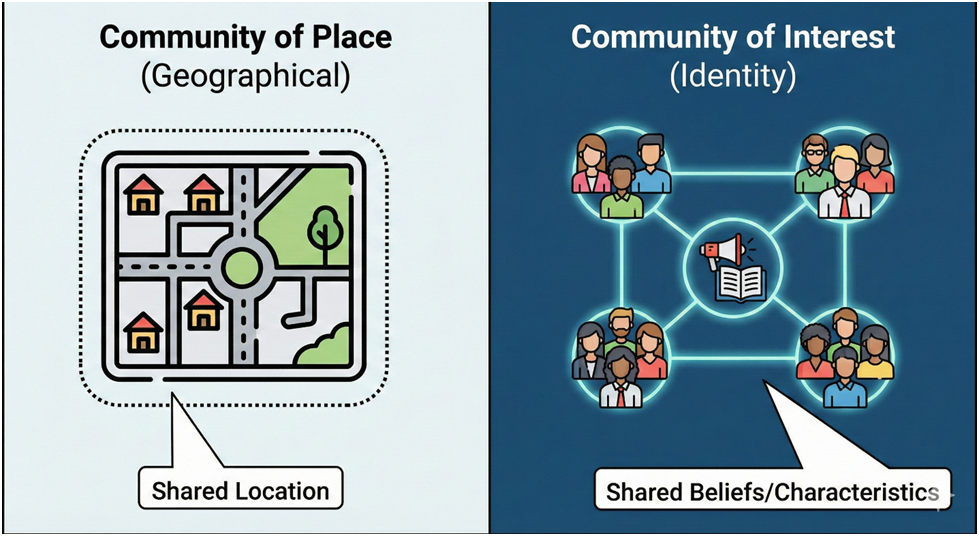
I. Types of Communities
In the UK, “Community” is rarely just one thing. It is usually a blend of:
- Community of Place (Geographical): Defined by physical boundaries (e.g., a specific postcode, a Housing Association estate, a rural village).
- Community of Interest (Identity): Defined by shared characteristics or beliefs, regardless of location (e.g. a Trade Union, a religious group).
II. Sociological Perspectives (The “Big Three” in Practice)
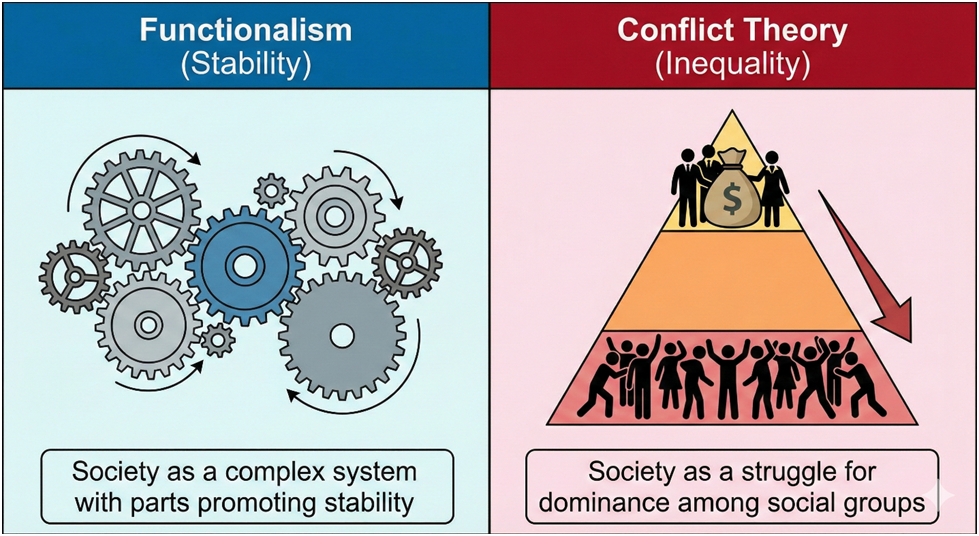
How do we view society’s problems?
- Functionalism: Views society as a complex system whose parts work together to promote stability.
- Practice: Focusing on how a community center “functions” to reduce crime and improve health.
- Conflict Theory (Marxism/Feminism): Views society as a struggle for dominance among social groups that compete for scarce resources.
- Practice: Advocacy work fighting against funding cuts that disproportionately affect working-class areas.
- Interactionism: Focuses on everyday social interactions and symbols.
- Practice: Looking at how labeling a neighborhood as a “sink estate” affects the self-esteem of the residents living there.
III. Agents of Socialisation
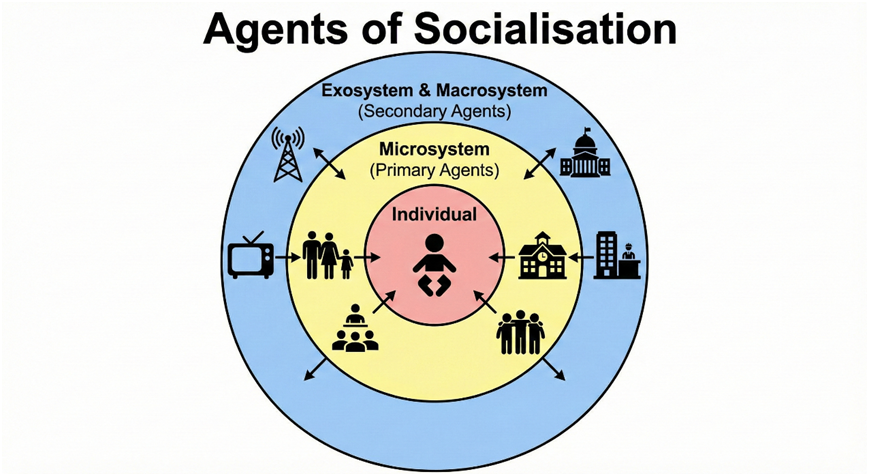
Where do people learn their values?
- Primary Agents: Family and close carers (early childhood).
- Secondary Agents: Education systems, Peer Groups, Mass Media, and the Workplace.
B. Learner Task Template
Task 1: Terminology Match-Up
Instructions: Review the definitions in the Knowledge Guide above. Below is a list of real-world scenarios you might encounter while working as a Community Development Officer in the UK.
Match the Scenario (Column A) with the correct Technical Term/Concept (Column B) and provide a brief Vocational Justification (1 sentence explaining why it fits).
| Scenario (Real-World Application) | Technical Term (Select from list) | Vocational Justification |
| 1. A local council reduces direct grants to a youth club, stating the club must become a self-sustaining business to survive in the free market. | (A) Social Capital | Example: This reflects Neoliberal Ideology because it prioritizes market-based solutions over state welfare. |
| 2. A community worker organizes a “Meet Your Neighbour” event to help residents of a new housing development build trust and share resources (like baby-sitting or car-pooling). | (B) Socialisation | |
| 3. You are working with a group of teenagers who have adopted specific dress codes and language from a popular UK Drill music channel on YouTube, influencing how they interact with police. | (C) Agency | |
| 4. A single mother feels she cannot attend community meetings because the venue has no wheelchair access and is held at a time that conflicts with her zero-hours contract shift. | (D) Neoliberal Ideology | |
| 5. A residents’ association realizes that despite the council’s plans to demolish their park, they have the legal right and collective power to launch a petition and stop the bulldozers. | (E) Secondary Socialisation | |
| 6. Residents of a specific postcode in East London band together to improve local air quality. | (F) Social Exclusion | |
| 7. A support group forms specifically for Somali women living in the UK to discuss shared cultural experiences and language barriers. | (G) Community of Place | |
| 8. A child learns from their parents that “community work is for other people, not us,” shaping their future reluctance to volunteer. | (H) Community of Interest | |
| (I) Primary Socialisation |
(Note: There are more Terms than Scenarios to test your discrimination skills.)
Learner Task Guideline
- Read the Knowledge Guide First: Do not attempt the match-up without understanding the nuance of the terms. For example, distinguish clearly between Primary and Secondary socialisation.
- Think “Vocational”: When writing your justification, don’t just copy the definition. Explain it as if you are writing a case note.
- Bad Example: “Because it fits the definition.”
- Good Example: “This is Social Capital because the worker is actively trying to create networks of trust between residents.”
- Context Matters: All scenarios are based on UK frameworks. Consider how laws like the Equality Act 2010 might influence concepts like Social Exclusion.
Submission Requirements
- Format: Please submit your completed Table (Task 1) in a standard Word Document (.docx) or PDF.
- Length: Your Vocational Justifications should be concise (approx. 20–30 words each).
- References: If you use outside sources to help with your definitions, please list them at the bottom of your document using Harvard Referencing style.