
Fire Risk Assessment Visual Learning Task
1. Introduction
Targeted Evidence Type: Completed workplace fire risk assessment reports
Welcome to this core competency module for Unit 02 of the ProQual Level 4 Award in Advanced Fire Risk Assessment. Moving from theoretical understanding to advanced vocational competency requires assessors to critically evaluate potential fire hazards and assess associated risks visually. You are expected to demonstrate advanced technical knowledge, analytical thinking, and professional application.
In the high-risk UK built environment, physical inspections are where statutory compliance meets physical reality. This Photo/Diagram Interpretation Task focuses specifically on your ability to observe, interpret, and recommend corrective actions based on raw visual data. The primary evidence generated from this task will directly contribute to your portfolio as completed workplace fire risk assessment reports. Remember, competence for each assessment criterion must be observed on at least two separate occasions before being awarded. This requires the candidate to carry out a minimum of two full fire risk assessments in high-risk buildings to demonstrate consistency and reliability of performance.
2. Knowledge Guide: Visual Defect Identification in High-Risk Buildings
Conducting a fire risk assessment is fundamentally an evidence-gathering exercise. In high-risk buildings (such as residential blocks over 18 metres), visual inspections act as the verification mechanism for the ‘Golden Thread’ of building safety information mandated by the Building Safety Act 2022. Assessors must operate using the OIR Framework: Observation, Interpretation, and Recommendation.
A. Observation: Identifying the Defect
Observation is the objective gathering of visual facts. It requires an assessor to distinguish between acceptable wear-and-tear and critical safety failures.
- External Walls: Under the Fire Safety Act 2021, the external walls and any attachments (like balconies) fall under the Regulatory Reform (Fire Safety) Order 2005 (FSO). You must visually identify the type of cladding (e.g., Aluminium Composite Material vs. High-Pressure Laminate) and look for degradation, missing cavity barriers, or exposed insulation.
- Compartmentation: You must look beyond the surface. Missing intumescent mastic around pipework passing through a concrete block wall is a visual indicator of a breached 120-minute fire compartment.
- Fire Doors: The Fire Safety (England) Regulations 2022 place strict duties on inspecting flat entrance doors. Visual observation must confirm the presence of correct hinges (three per door, CE marked), functional self-closing devices, and intact intumescent strips and cold smoke seals.
B. Interpretation: Applying UK Law to the Visual Evidence
Once a defect is observed, you must vocationally interpret its impact on the building’s life-safety strategy.
- If you observe a wedge holding open a cross-corridor fire door, the interpretation is not simply “a door is open.” The interpretation is: “The primary means of escape has been compromised, allowing unimpeded smoke travel, directly violating the Responsible Person’s duties under Article 8 of the FSO 2005.”
C. Recommendation: Vocational Problem Solving
Recommendations must be specific, time-bound, and proportionate.
- Poor Recommendation: “Fix the fire door.”
- Vocational Recommendation: “Immediately remove the wedge. Within 7 days, engage a BM TRADA certified contractor to install acoustic magnetic hold-open devices linked directly to the main fire alarm control panel to facilitate operational flow while maintaining compartmentation during an alarm state.”
Key Reference Texts for Interpretation:
- HM Government, Fire Safety in Purpose-Built Blocks of Flats, 2023.
- Institution of Fire Engineers, Guide to Visual Inspections of Fire Doors, 2024.
- British Standards Institution, PAS 79-1:2020 Fire Risk Assessment, 2020.
3. Learner Task: The “Kingsway Tower” Image Audit
Scenario Overview: You are acting as the Lead Fire Risk Assessor for “Kingsway Tower,” a 15-storey mixed-use building in Leeds. You have conducted your site walkaround and taken several photographs of critical areas. The Principal Accountable Person (PAP) is a private management firm that has historically been defensive regarding maintenance budgets.
You must review the four specific visual scenarios detailed below and complete the corresponding sections of your anonymised fire risk assessment report.
Image Scenario 1: The Stairwell Escape Route
Observation: Upon entering the primary protected stairwell on Level 4, you photograph multiple large cardboard boxes, a cleaning trolley, and loose rubbish bags completely blocking the landing and reducing the egress width to less than 0.5 metres.
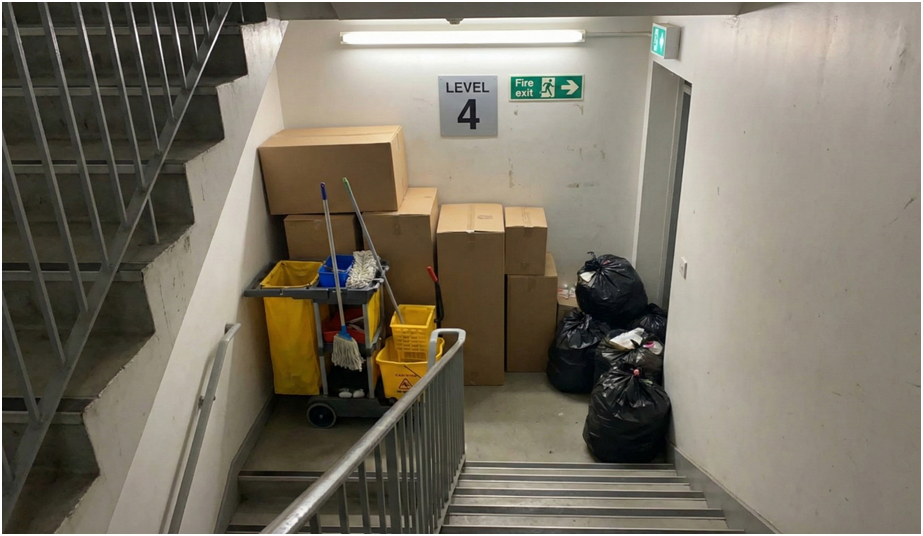
Image Scenario 2: Service Riser Compartmentation
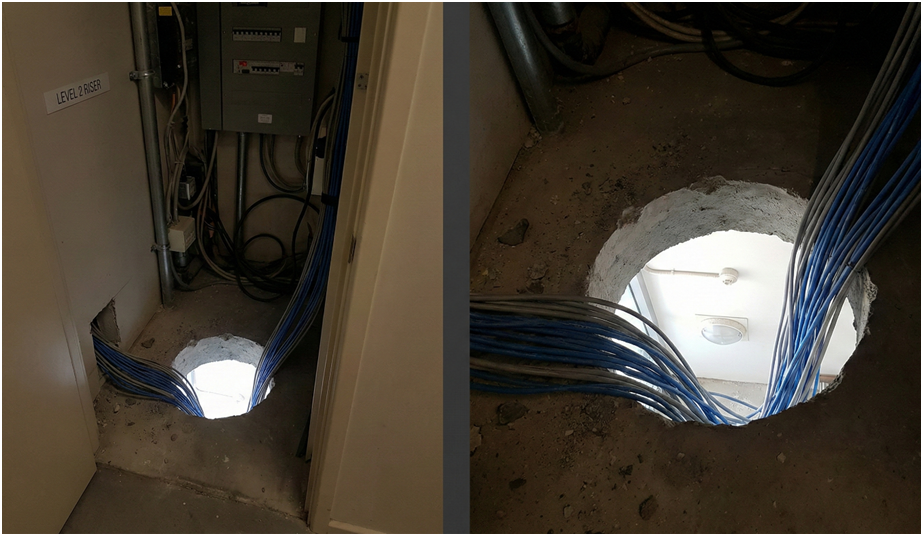
Observation: Inside the electrical service riser cupboard on Level 2, you photograph a newly drilled hole measuring 150mm in diameter passing through the concrete floor slab. Several new data cables have been pulled through, but there is no intumescent fire-stopping compound applied. You can see daylight from the floor below.
Image Scenario 3: Flat Entrance Door Defect
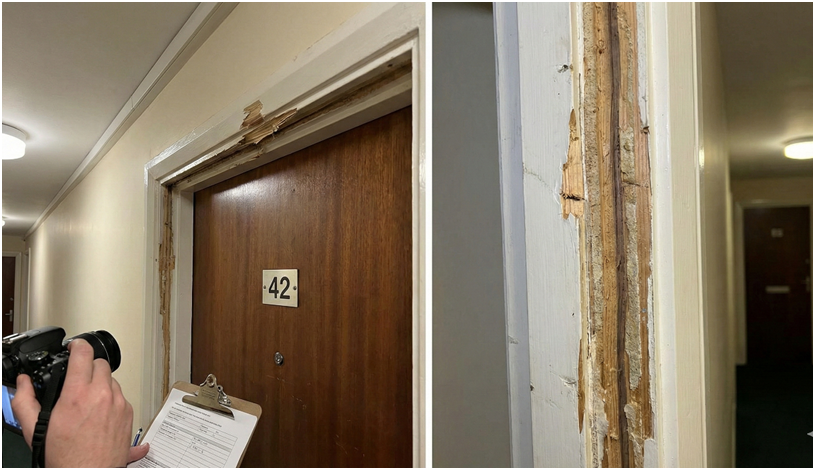
Observation: While inspecting a sample of flat entrance doors under the Fire Safety Act 2021, you photograph the door to Flat 42. The timber frame is severely damaged, and the combined intumescent strip and cold smoke seal has been entirely ripped out along the top and latch side of the frame.
Image Scenario 4: External Wall Degradation
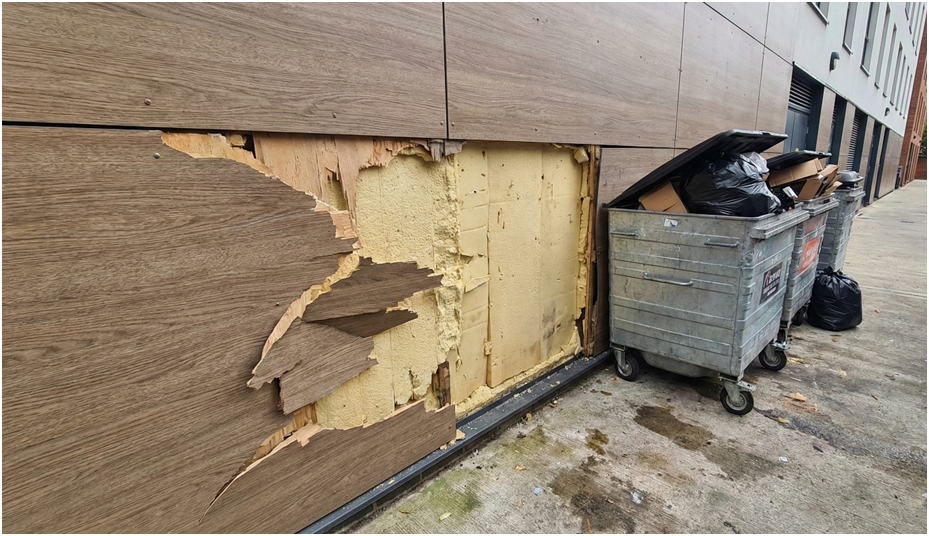
Observation: While inspecting the exterior, you photograph a section of the High-Pressure Laminate (HPL) cladding near the ground floor commercial bin store. A panel is broken, revealing exposed, combustible rigid foam insulation directly adjacent to where commercial waste bins are stored.
Guided Report Questions
You are required to process these visual scenarios to build the narrative of your fire risk assessment report.
Strict Length Requirement: You must write exactly 350 words for each of your answers to the four questions below to demonstrate the depth of your technical knowledge.
Question 1: Preparation (Prepare to carry out a fire risk assessment…)
Based on Image Scenario 4 (External Wall Degradation), how does interpreting this specific visual defect instantly alter your preparatory and documentary requests from the Principal Accountable Person? Detail the legal significance of the exposed insulation under the Fire Safety Act 2021 and outline the exact documentation (e.g., PAS 9980 report, EWS1 form) you must now demand to validate the building’s overall safety case.
Question 2: Hazard Evaluation (Conduct a fire risk assessment…)
Critically evaluate the visual evidence in Image Scenario 2 (Service Riser Compartmentation) and Image Scenario 3 (Flat Entrance Door). Conduct a mini-assessment of these hazards. Explain the physical mechanics of how fire and cold smoke will behave due to these specific defects, and detail how these failures directly compromise the “Stay Put” evacuation strategy legally required in purpose-built flats.
Question 3: Stakeholder Communication (Communicate effectively with relevant stakeholders…)
Focusing on Image Scenario 1 (Blocked Stairwell), draft the formal communication you will send to the building’s facilities management team. This must effectively communicate the immediate severity of the blocked escape route. Explicitly reference their legal duties under Article 14 of the Regulatory Reform (Fire Safety) Order 2005. How will you ensure this communication is documented as part of your assessment evidence?
Question 4: Action Plan & Professional Conduct (Demonstrate appropriate and professional behaviour…)
During the debrief, the building manager reviews your photos and dismisses the missing fire-stopping in Image 2 as a “minor contractor mistake” that doesn’t need to be in the final report. Demonstrate appropriate and professional behaviour by drafting your verbal response. Then, develop comprehensive, evidence-based recommendations to reduce risk and improve fire safety management systems for both the compartmentation breach and the damaged fire door, providing strict, legally compliant timeframes for remediation.
4. Submission Guidelines
To ensure full compliance with the Inspire College of Technologies UK Ltd (ICT Qual) assessment protocols and internal quality assurance, learners must adhere strictly to the following submission guidelines:
- Submission Method: All coursework and evidence must be submitted through the online dashboard in PDF or scanned format.
- File Naming Convention: File naming must follow a standard format. Please save your completed assignment as: “Unit2_YourName_PhotoInterpretation”.
- Word Count Compliance: As strictly mandated in the learner task, you must provide exactly 350 words for each of the four guided questions.
- Authentication & Formatting: Ensure all documents are authentic, relevant, and properly organized. Each document should include “Prepared by/Provided by [Your Name & Signature]” either at the beginning or end. Use clear indexing and consistent labeling to enable smooth assessment review.
- Confidentiality: Maintain confidentiality by anonymizing sensitive information before submission. Ensure the fictionalized details of “Kingsway Tower” are used throughout your answers.
- Feedback & Progression: Comprehensive and constructive feedback is provided for all assignments. Detailed feedback will be provided via the dashboard, including identified strengths, areas requiring improvement, and recommendations for enhancing the quality of work. Learners must act on feedback and resubmit if required. Resubmissions are normally due within 7-10 working days, as communicated via the dashboard. Progression to the next unit is only permitted after feedback approval.
- Academic and Administrative Support: If you require clarification on expectations or assessment evidence requirements, support is available through the dashboard, email, or scheduled Zoom sessions.