LICQual Level 7 Diploma in Pharmacy Ethics & Law
Pharmacy is more than science—it is a profession built on trust, responsibility, and accountability. Every decision made by pharmacists has the potential to impact patient lives, making ethical judgment and legal compliance essential to safe practice. In an era where healthcare systems are under increasing scrutiny, the importance of pharmacy ethics and law cannot be overstated. This discipline ensures that professionals not only understand the science behind medicines but also the moral and legal frameworks that govern their use.
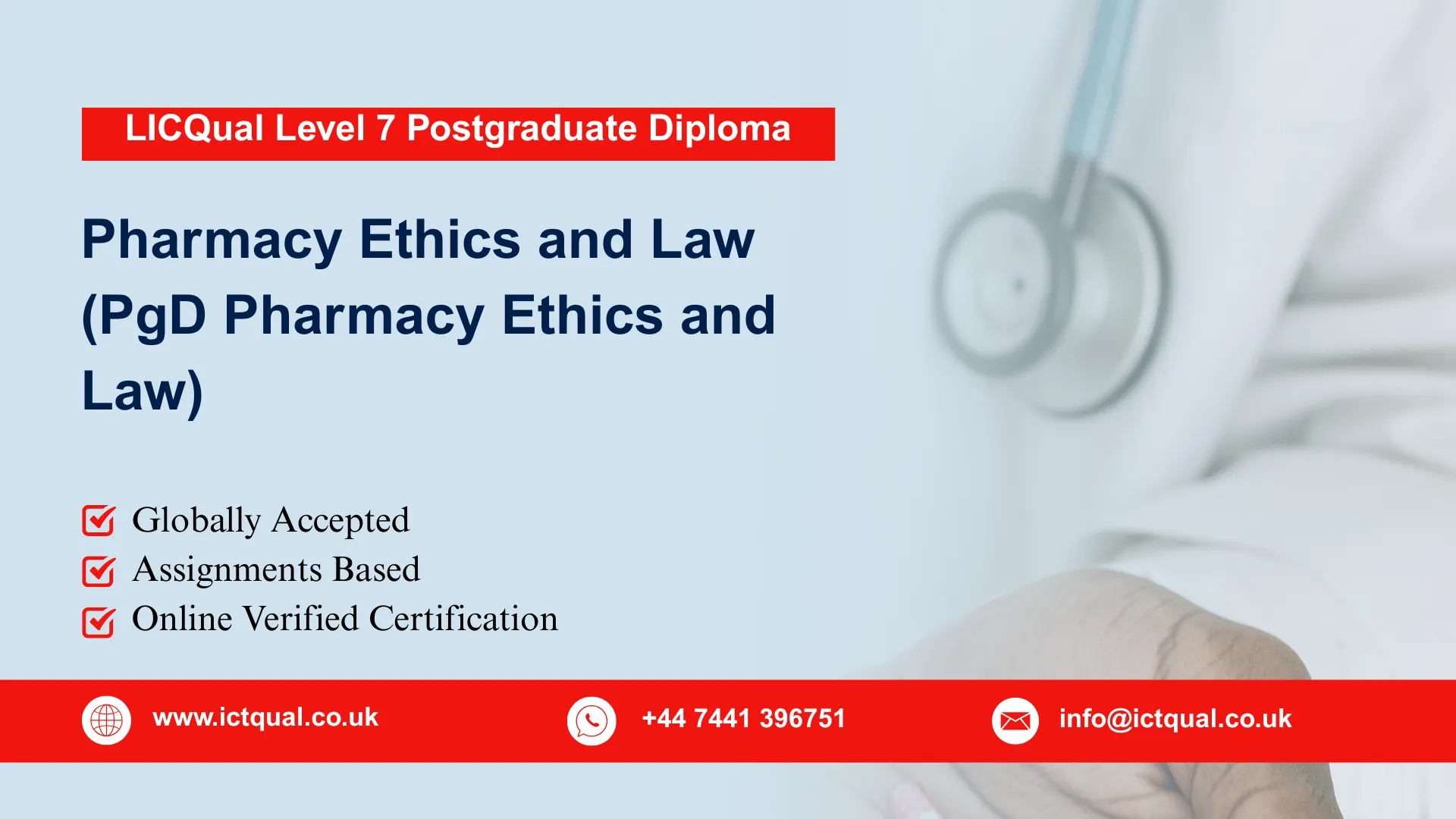
The LICQual Level 7 Postgraduate Diploma in Pharmacy Ethics and Law (PgD Pharmacy Ethics and Law) highlights the critical role of ethics and legislation in modern pharmaceutical practice. Pharmacy ethics and law guide professionals in navigating dilemmas such as patient confidentiality, informed consent, regulatory compliance, and responsible prescribing. For learners, engaging with this subject is more than academic—it is an opportunity to strengthen credibility, safeguard patient rights, and contribute to a healthcare system built on integrity. By mastering pharmacy ethics and law, professionals position themselves as leaders who uphold both the science and the values of healthcare.
Program Outline
The LICQual Level 7 Postgraduate Diploma in Pharmacy Ethics and Law (PgD Pharmacy Ethics and Law) is a structured qualification designed to provide learners with advanced expertise in ethical decision‑making and legal compliance within pharmaceutical practice. Comprising 6 specialized units and worth 120 credits, the program introduces learners to areas such as healthcare legislation, professional accountability, patient rights, regulatory frameworks, ethical dilemmas, and global best practices in pharmacy ethics and law.
This section explains how the course equips learners with the ability to understand pharmacy ethics and law, apply evidence‑based approaches, and align with international standards effectively. It highlights the type of learners the program is aimed at, the skills they will gain, and the career pathways available upon completion. Readers will also discover how this internationally recognized qualification opens opportunities in hospitals, community pharmacies, pharmaceutical companies, and research institutions, making it a valuable credential for anyone aspiring to build a career in pharmacy ethics and law.
Unit Structure
| Qualification | Unit Title | Credits | GLH |
| LICQ2201243-1 | Advanced Principles of Pharmacy Ethics | 20 | 100 |
| LICQ2201243-2 | Legal Frameworks Governing Pharmacy Practice | 20 | 100 |
| LICQ2201243-3 | Clinical Governance and Professional Accountability | 20 | 100 |
| LICQ2201243-4 | Regulatory Compliance and Risk Management | 20 | 100 |
| LICQ2201243-5 | Research Ethics and Evidence-Based Practice | 20 | 100 |
| LICQ2201243-6 | Contemporary Issues in Pharmacy Ethics and Law | 20 | 100 |
Who Can Benefit
The LICQual Level 7 Postgraduate Diploma in Pharmacy Ethics and Law (PgD Pharmacy Ethics and Law) is designed for individuals who want to specialize in ethical practice, legal compliance, and professional responsibility in healthcare. This program is particularly valuable for those who aim to address challenges such as patient confidentiality, regulatory adherence, and ethical dilemmas in pharmaceutical services. It helps learners strengthen their expertise, improve employability, and prepare for roles where pharmacy ethics and law are central to healthcare delivery.
Ideal Learners
- Students aspiring to enter pharmaceutical sciences with a focus on ethics and law.
- Entry‑level professionals seeking structured training in pharmacy ethics and law.
- Pharmacy assistants wanting to expand knowledge of patient rights and compliance.
- Community pharmacy staff preparing for responsibilities in ethical healthcare services.
- Hospital pharmacy technicians aiming to strengthen skills in accountability and patient safety.
- Healthcare professionals transitioning into pharmacy ethics and law roles.
- Career changers interested in pharmaceutical governance and ethical practice.
- Ambitious learners who want to develop practical skills for pharmacy ethics and law careers.
What You’ll Be Able to Do
Unit 1: Advanced Principles of Pharmacy Ethics
Learners will be able to:
- Analyse and evaluate key ethical principles relevant to pharmacy practice, including patient autonomy, confidentiality, and professional responsibility.
- Apply ethical frameworks to resolve complex dilemmas in clinical and community pharmacy settings.
- Demonstrate critical thinking in ethical decision-making to enhance patient care and professional practice.
Unit 2: Legal Frameworks Governing Pharmacy Practice
Learners will be able to:
- Interpret national and international legislation affecting pharmacy practice, licensing, and regulatory compliance.
- Assess legal responsibilities and professional liability in diverse pharmacy settings.
- Apply knowledge of pharmacy law to ensure lawful and safe delivery of services.
Unit 3: Clinical Governance and Professional Accountability
Learners will be able to:
- Evaluate clinical governance frameworks and their impact on pharmacy practice.
- Develop strategies to maintain professional accountability and ethical standards in healthcare environments.
- Critically assess policies and procedures to improve service quality and patient safety.
Unit 4: Regulatory Compliance and Risk Management
Learners will be able to:
- Analyse regulatory requirements and quality assurance processes within pharmacy practice.
- Design and implement effective risk management strategies to mitigate professional and clinical risks.
- Evaluate compliance systems to ensure continuous improvement and adherence to standards.
Unit 5: Research Ethics and Evidence-Based Practice
Learners will be able to:
- Apply ethical principles to the conduct of research in pharmacy and healthcare.
- Critically evaluate evidence from clinical trials and scientific studies to inform practice.
- Demonstrate the ability to integrate research findings into evidence-based decision-making.
Unit 6: Contemporary Issues in Pharmacy Ethics and Law
Learners will be able to:
- Analyse emerging trends and challenges in pharmacy ethics and law, including digital health and patient data protection.
- Critically evaluate complex scenarios to develop ethical and legally compliant solutions.
- Demonstrate innovative problem-solving skills in addressing contemporary issues in pharmacy practice.