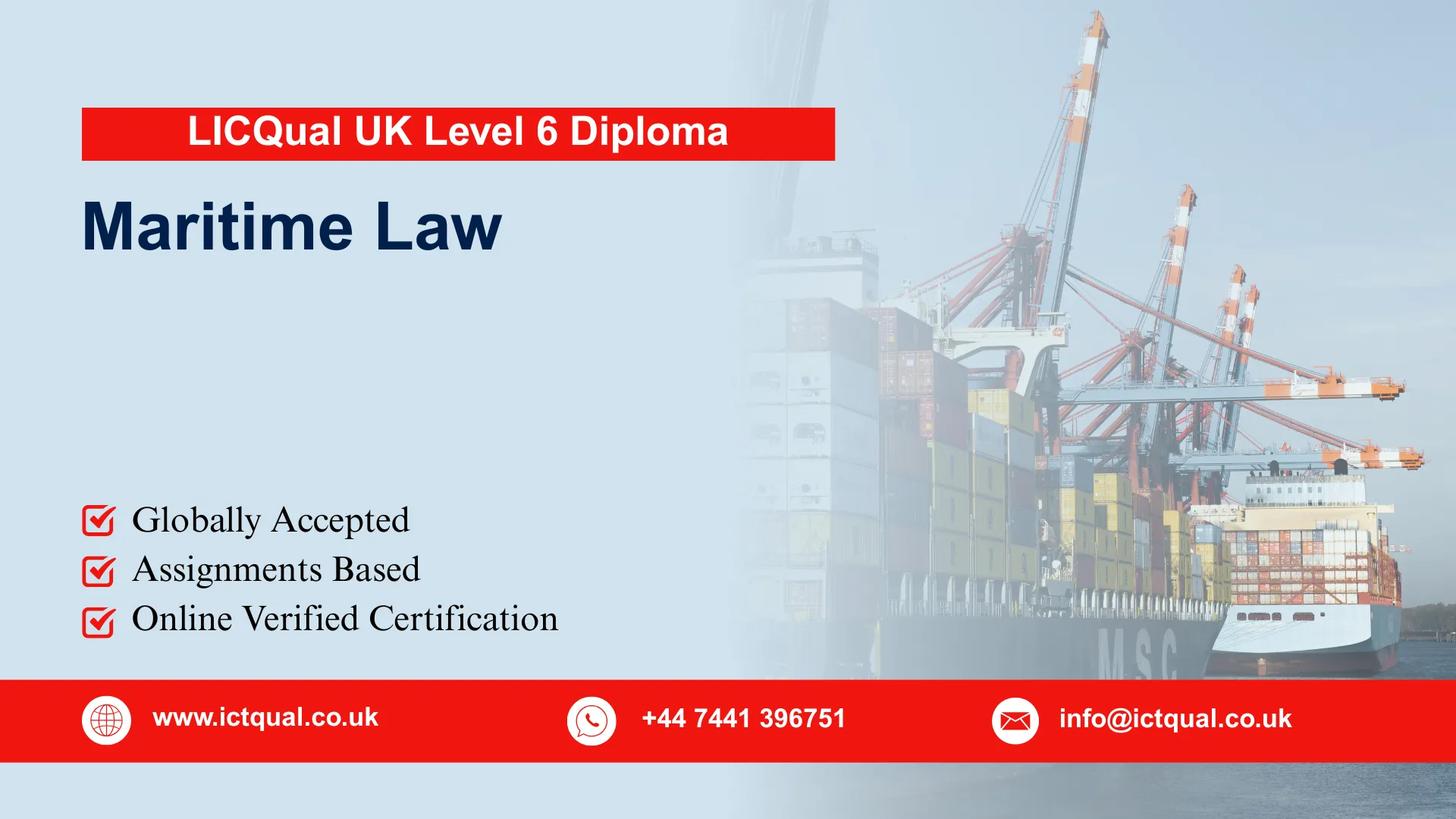
LICQual Level 6 Diploma in Maritime Law UK
Maritime law is the foundation of international trade, shaping the rules that govern ships, cargo, and contracts across the globe. It is a discipline that ensures fairness, accountability, and compliance in one of the world’s most vital industries. Every shipment that crosses the oceans, every charter agreement signed, and every dispute resolved depends on the principles of maritime law. Without this framework, global commerce would face uncertainty, inefficiency, and risk.
The LICQual UK Level 6 Diploma in Maritime Law emphasizes the importance of advanced expertise in this field. At this level, professionals are expected to master complex international conventions, liability issues, and dispute resolution strategies while navigating the evolving challenges of global trade. As shipping adapts to digitalization, sustainability, and stricter compliance requirements, the demand for highly skilled leaders in maritime law has never been greater. For ambitious learners, excelling in maritime law is not just about understanding legal rules—it is about safeguarding the integrity of global supply chains and contributing to the resilience of international commerce.
Program Outline
The LICQual UK Level 6 Diploma in Maritime Law is an advanced qualification designed to prepare learners for senior responsibilities in the legal and maritime sectors. Comprising 6 specialized units and worth 120 credits, the program provides a structured pathway to mastering international conventions, liability management, contract law, and dispute resolution.
This section of the article explains how the diploma equips learners with the ability to interpret complex maritime agreements, manage compliance, and apply international standards effectively. It highlights the type of learners the course is aimed at, the advanced skills they will gain, and the career pathways available upon completion. Readers will also discover how this internationally recognized qualification opens opportunities in shipping companies, law practices, logistics firms, and trade organizations, making it a valuable credential for professionals seeking to progress into leadership roles in maritime law.
Unit Structure
| Qualification | Unit Title | Credits | GLH |
| LICQ2201306-1 | Advanced Principles of Maritime and Shipping Law | 20 | 80 |
| LICQ2201306-2 | Carriage of Goods and International Trade Law | 20 | 80 |
| LICQ2201306-3 | Admiralty Law and Marine Environmental Protection | 20 | 80 |
| LICQ2201306-4 | Marine Insurance and Risk Management | 20 | 80 |
| LICQ2201306-5 | International Maritime Conventions and Compliance | 20 | 80 |
| LICQ2201306-6 | Research Project in Maritime Law | 20 | 80 |
Who Can Benefit
The LICQual UK Level 6 Diploma in Maritime Law is designed for individuals aiming to advance their careers in the maritime and legal industries. This program is especially valuable for professionals who face challenges such as interpreting complex contracts, resolving disputes, or ensuring compliance with international conventions. It helps learners strengthen their expertise, gain confidence, and prepare for senior positions where maritime law is central to global trade.
Ideal Learners
- Experienced shipping staff aiming for supervisory or managerial positions.
- Law graduates seeking advanced specialization in maritime law.
- Port authority employees who want to expand their knowledge of legal compliance.
- Logistics specialists preparing for leadership roles in international trade.
- Maritime safety officers looking to enhance regulatory expertise and decision‑making skills.
- Supply chain managers transitioning into legal aspects of shipping.
- Career changers seeking an internationally recognized qualification in maritime law.
- Ambitious learners who want to build strategic skills for global shipping opportunities.
What You’ll Be Able to Do
Unit 1: Advanced Principles of Maritime and Shipping Law
By the end of this unit, learners will be able to:
- Critically evaluate the advanced principles of maritime and shipping law in global trade.
- Analyze the interaction between national legal systems and international maritime frameworks.
- Apply advanced legal reasoning to complex shipping contracts and disputes.
- Assess the role of maritime law in regulating ship operations, ownership, and liabilities.
- Compare and contrast case law precedents across different jurisdictions.
- Demonstrate the ability to synthesize legal principles into practical maritime solutions.
Unit 2: Carriage of Goods and International Trade Law
By the end of this unit, learners will be able to:
- Interpret advanced legal frameworks governing carriage of goods by sea and multimodal transport.
- Evaluate the application of Hague‑Visby, Hamburg, and Rotterdam Rules in international trade.
- Analyze liability issues in cargo loss, damage, and delay under complex shipping contracts.
- Apply legal principles to real‑world disputes involving bills of lading and charterparties.
- Assess the impact of international trade law on global supply chain efficiency.
- Formulate strategies for risk management in international carriage of goods.
Unit 3: Admiralty Law and Marine Environmental Protection
By the end of this unit, learners will be able to:
- Critically assess admiralty jurisdiction and its role in resolving maritime disputes.
- Evaluate legal frameworks for ship arrest, salvage, and maritime liens.
- Analyze international conventions addressing marine pollution and environmental protection.
- Apply admiralty law principles to case studies involving ship ownership and liability.
- Assess the effectiveness of international regulations in protecting marine ecosystems.
- Recommend compliance strategies for shipping companies under environmental law.
Unit 4: Marine Insurance and Risk Management
By the end of this unit, learners will be able to:
- Evaluate advanced principles of marine insurance, including indemnity, subrogation, and utmost good faith.
- Analyze the role of marine insurance in mitigating risks in international shipping.
- Apply legal frameworks to complex insurance claims involving cargo, hull, and liability.
- Assess the impact of international conventions on marine insurance practices.
- Formulate strategies for effective risk management in maritime trade.
- Demonstrate the ability to resolve disputes arising from marine insurance contracts.
Unit 5: International Maritime Conventions and Compliance
By the end of this unit, learners will be able to:
- Identify and evaluate key conventions such as UNCLOS, SOLAS, MARPOL, and STCW.
- Analyze the role of the International Maritime Organization (IMO) in global compliance.
- Apply international conventions to case studies involving safety, security, and environmental protection.
- Assess the challenges of harmonizing maritime law across jurisdictions.
- Recommend compliance strategies for shipping companies operating globally.
- Critically evaluate the effectiveness of international conventions in regulating maritime activities.
Unit 6: Research Project in Maritime Law
By the end of this unit, learners will be able to:
- Design and conduct independent research on a specialized area of maritime law.
- Critically analyze primary and secondary legal sources to support arguments.
- Apply advanced research methodologies to maritime legal issues.
- Synthesize findings into a structured, evidence‑based research report.
- Evaluate the implications of research outcomes for maritime law practice and policy.
- Demonstrate professional academic writing and presentation skills in line with international standards.