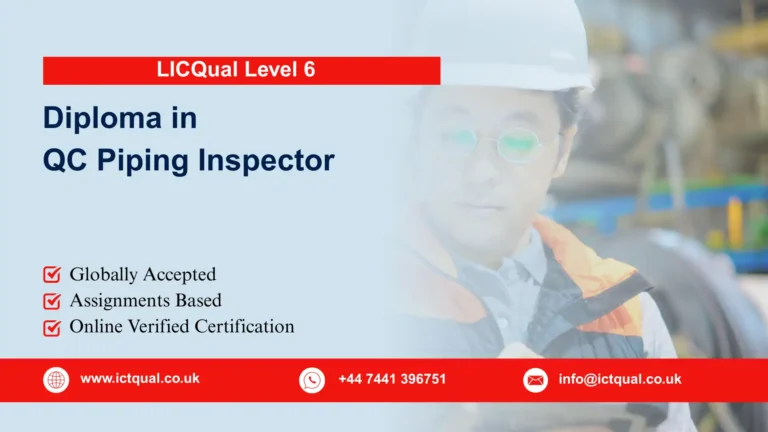
The LICQual Level 3 Diploma in Quality Control (QC) Piping is a UK-based qualification designed for individuals who want to establish a strong career in piping inspection, monitoring, and quality assurance. This diploma program equips learners with the technical knowledge and practical skills necessary to ensure that piping systems meet industry standards, engineering specifications, and regulatory requirements. It provides a solid foundation for professionals who aim to contribute to safety, reliability, and quality in industries such as oil and gas, petrochemicals, construction, and power generation.
The course focuses on the essential principles of piping quality control, including material inspection, welding procedures, non-destructive testing, and quality documentation. Learners are trained to identify defects, verify compliance with project standards, and apply internationally recognized quality assurance practices. By covering both theoretical concepts and practical applications, the program prepares participants to handle real-world challenges in piping projects with confidence and competence.
One of the key advantages of the LICQual Level 3 Diploma in Quality Control (QC) Piping is its assignment-based assessment structure. This flexible approach allows learners to demonstrate their understanding through practical assignments rather than traditional examinations, making it ideal for working professionals and individuals seeking career advancement without disrupting their current roles. The structure encourages critical thinking and problem-solving, ensuring graduates are ready to perform effectively in quality control environments.
Completing this diploma not only enhances professional knowledge but also opens up diverse career opportunities. Successful learners can pursue roles such as piping inspector, quality control engineer, welding inspector, or QA/QC supervisor. With industries worldwide prioritizing quality and safety, qualified QC professionals are in high demand, and this diploma provides an internationally recognized credential to support career growth.
The LICQual Level 3 Diploma in Quality Control (QC) Piping is an excellent choice for those looking to develop specialized expertise in piping quality assurance. It is particularly suitable for individuals working in or aspiring to join industries where piping systems are critical to operational performance. By gaining this qualification, learners position themselves as skilled professionals capable of ensuring compliance, safety, and quality in complex projects.
The LICQual Level 3 Diploma in Quality Control (QC) Piping is a specialized UK-based qualification developed to provide learners with in-depth knowledge and practical skills in piping inspection and quality assurance. This program focuses on the principles and practices required to monitor, evaluate, and maintain the quality of piping systems in compliance with international standards and industry codes.
The course covers essential topics such as material identification, welding processes, inspection techniques, non-destructive testing methods, and quality documentation. Learners are equipped with the expertise to identify defects, interpret technical drawings, and ensure adherence to project specifications. By combining theoretical knowledge with practical applications, the diploma prepares participants to meet the rigorous demands of industries such as oil and gas, petrochemicals, construction, and power generation.
The program is assessed through assignments, offering a flexible and learner-friendly approach that enables participants to apply their knowledge to real-world scenarios. This structure ensures that learners develop strong analytical, problem-solving, and decision-making skills required for quality control roles.
Upon successful completion, graduates of the LICQual Level 3 Diploma in Quality Control (QC) Piping can pursue career opportunities as piping inspectors, QC engineers, QA/QC supervisors, or welding inspectors. This qualification serves as a pathway to career advancement, professional recognition, and further studies in quality assurance and engineering disciplines.
The LICQual Level 3 Diploma in Quality Control (QC) Piping qualification consists of 6 mandatory units required for completion.
Mandatory Units
| Unit# | Unit Title |
| 1 | Principles of Slinging and Lifting Equipment |
| 2 | Risk Assessment and Safe Systems of Work for Lifting Operations |
| 3 | Inspection, Maintenance, and Storage of Lifting Gear |
| 4 | Understanding Load Characteristics and Centre of Gravity |
| 5 | Slinging Techniques and Signal Communication |
| 6 | Legal, Regulatory and Industry Standards for Slinging |
The LICQual Level 3 Diploma in Quality Control (QC) Piping is designed for individuals who aspire to build a career in piping inspection, monitoring, and quality assurance across a wide range of industries. It is particularly suitable for:
- Fresh graduates in engineering or technical fields who want to enter the quality control and inspection profession.
- Working professionals seeking to enhance their skills in piping quality assurance and move into specialized QC roles.
- Technicians, supervisors, and engineers who are involved in piping projects within oil and gas, petrochemical, construction, and power generation sectors.
- Individuals aiming to gain an internationally recognized qualification to boost their employability and career progression.
- Professionals planning to transition from general engineering or construction roles into quality control and quality assurance positions.
This course is ideal for anyone who wants to acquire practical, job-ready knowledge in piping QC and contribute to ensuring safety, compliance, and reliability in industrial projects.
Upon completing this Course students will be able to:
1. Principles of Slinging and Lifting Equipment
- Understand the basic principles of slinging and lifting operations
- Identify different types of lifting equipment and their applications
- Demonstrate knowledge of safe handling and usage of lifting accessories
2. Risk Assessment and Safe Systems of Work for Lifting Operations
- Conduct effective risk assessments for lifting activities
- Apply safe systems of work to minimize hazards during lifting operations
- Recognize potential risks and implement appropriate control measures
3. Inspection, Maintenance, and Storage of Lifting Gear
- Carry out pre-use checks and detailed inspections of lifting gear
- Understand correct procedures for maintenance and servicing of equipment
- Apply proper methods for safe storage and handling of lifting accessories
4. Understanding Load Characteristics and Centre of Gravity
- Analyze load weight, shape, and stability before lifting
- Determine the centre of gravity and its importance in safe lifting
- Apply correct lifting techniques to ensure balanced and stable operations
5. Slinging Techniques and Signal Communication
- Demonstrate proper slinging methods for different load types
- Use standard hand and radio signals effectively during lifting operations
- Coordinate safely with crane operators and lifting team members
6. Legal, Regulatory and Industry Standards for Slinging
- Understand relevant legislation, codes of practice, and industry guidelines
- Apply regulatory requirements to ensure compliance in lifting operations
- Demonstrate awareness of responsibilities and duties under safety standards