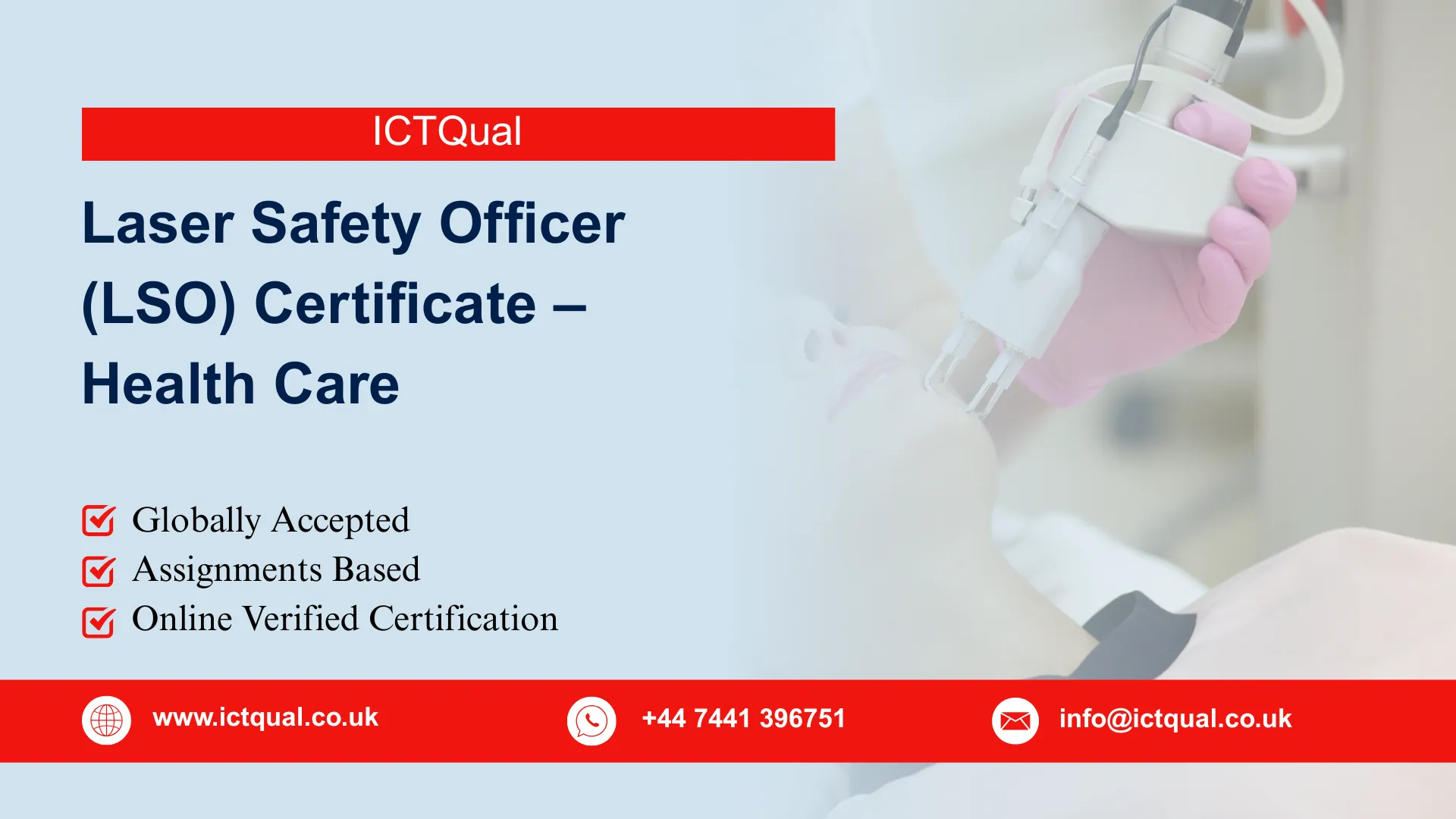
The ICTQual Laser Safety Officer (LSO) Certificate – Health Care is a specialized training program designed to prepare professionals working in medical and clinical environments to manage and oversee laser safety. With the increasing use of laser technologies in healthcare—ranging from surgical procedures and dermatology to ophthalmology and cosmetic treatments—the role of a qualified Laser Safety Officer has become essential to ensure patient and staff safety, regulatory compliance, and effective risk management.
This certificate program provides learners with a strong foundation in laser physics, biological effects of laser exposure, hazard evaluation, protective measures, and healthcare-specific safety protocols. Through structured study units and practical applications, participants gain the competence to implement safety standards, conduct risk assessments, and establish compliance frameworks tailored to medical settings.
By the end of the course, graduates are equipped to take on responsibilities as designated Laser Safety Officers in hospitals, clinics, and specialized healthcare facilities, contributing to safer practices and improved patient outcomes.
The ICTQual Laser Safety Officer (LSO) Certificate – Health Care is a specialized qualification designed to prepare professionals in medical and clinical environments to manage and oversee laser safety. Structured into 5 study units and carrying 10 credits, this program equips learners with both theoretical knowledge and practical skills tailored to healthcare settings where lasers are widely used in surgery, dermatology, ophthalmology, and cosmetic treatments.
The course covers essential topics such as laser physics, biological effects of laser exposure, hazard evaluation, protective measures, and healthcare-specific safety protocols. Emphasis is placed on risk assessment, regulatory compliance, and the responsibilities of a designated Laser Safety Officer in hospitals, clinics, and specialized medical facilities. By combining academic study with real-world applications, participants gain the competence to implement safety standards, conduct audits, and ensure patient and staff protection.
This qualification, the ICTQual Laser Safety Officer (LSO) Certificate – Health Care, consists of 5 mandatory units.
Mandatory Units
- Principles of Laser Physics and Medical Applications
- Healthcare Laser Safety Standards and Regulatory Compliance
- Risk Assessment, Hazard Control, and Safety Protocols
- Operational Responsibilities of the Laser Safety Officer (LSO)
- Audit, Training, and Continuous Improvement in Healthcare Laser Safety
The ICTQual Laser Safety Officer (LSO) Certificate – Health Care is designed for professionals working in medical and clinical environments where laser technologies are widely applied. It is particularly suited for:
- Doctors and surgeons using lasers in surgical procedures.
- Dermatologists and cosmetic specialists applying lasers in skin treatments and aesthetic care.
- Ophthalmologists and eye-care professionals utilizing lasers in corrective and therapeutic procedures.
- Nurses and clinical staff assisting in laser-based treatments and patient care.
- Hospital safety officers and compliance managers responsible for ensuring safe use of medical laser systems.
- Healthcare technicians and biomedical engineers maintaining and operating laser equipment in clinical settings.
- Healthcare institutions and employers aiming to upskill staff to meet international standards for laser safety.
This certificate is ideal for anyone committed to ensuring patient safety, protecting healthcare staff, and maintaining compliance with international laser safety regulations. By completing the program, learners demonstrate readiness to serve as designated Laser Safety Officers in hospitals, clinics, and specialized medical facilities.
Learning Outcomes for the ICTQual Laser Safety Officer (LSO) Certificate – Health Care:
Principles of Laser Physics and Medical Applications
- Understand the fundamental principles of laser generation and operation.
- Identify different types of medical lasers and their clinical applications.
- Explain the interaction of laser energy with biological tissues.
- Recognise the benefits and limitations of laser use in healthcare.
- Apply knowledge of laser physics to practical healthcare scenarios.
- Evaluate emerging trends in medical laser technology.
- Relate theoretical concepts to safe and effective patient care.
Healthcare Laser Safety Standards and Regulatory Compliance
- Interpret international standards governing healthcare laser safety.
- Apply regulatory frameworks to clinical laser operations.
- Demonstrate awareness of national and local compliance requirements.
- Ensure adherence to workplace health and safety legislation.
- Implement policies that align with recognised safety standards.
- Assess organisational responsibilities for laser safety compliance.
- Promote a culture of accountability and regulatory awareness.
Risk Assessment, Hazard Control, and Safety Protocols
- Conduct systematic risk assessments for laser use in healthcare.
- Identify potential hazards associated with medical laser procedures.
- Develop effective hazard control measures and safety protocols.
- Implement protective strategies for patients and staff.
- Evaluate the effectiveness of existing safety procedures.
- Apply incident reporting and corrective action frameworks.
- Integrate risk management into daily healthcare practice.
Operational Responsibilities of the Laser Safety Officer (LSO)
- Define the role and responsibilities of a Laser Safety Officer.
- Oversee safe operation of medical lasers in healthcare facilities.
- Coordinate with multidisciplinary teams to ensure compliance.
- Manage safety documentation and operational records.
- Provide guidance on equipment maintenance and calibration.
- Support staff in adhering to laser safety procedures.
- Lead by example in promoting safe laser practices.
Audit, Training, and Continuous Improvement in Healthcare Laser Safety
- Plan and conduct internal audits of laser safety programmes.
- Evaluate compliance with established safety standards.
- Deliver effective training sessions for healthcare staff.
- Monitor learner progress and reinforce safety awareness.
- Recommend improvements based on audit findings.
- Establish continuous improvement strategies for laser safety.
- Contribute to organisational excellence in healthcare risk management.