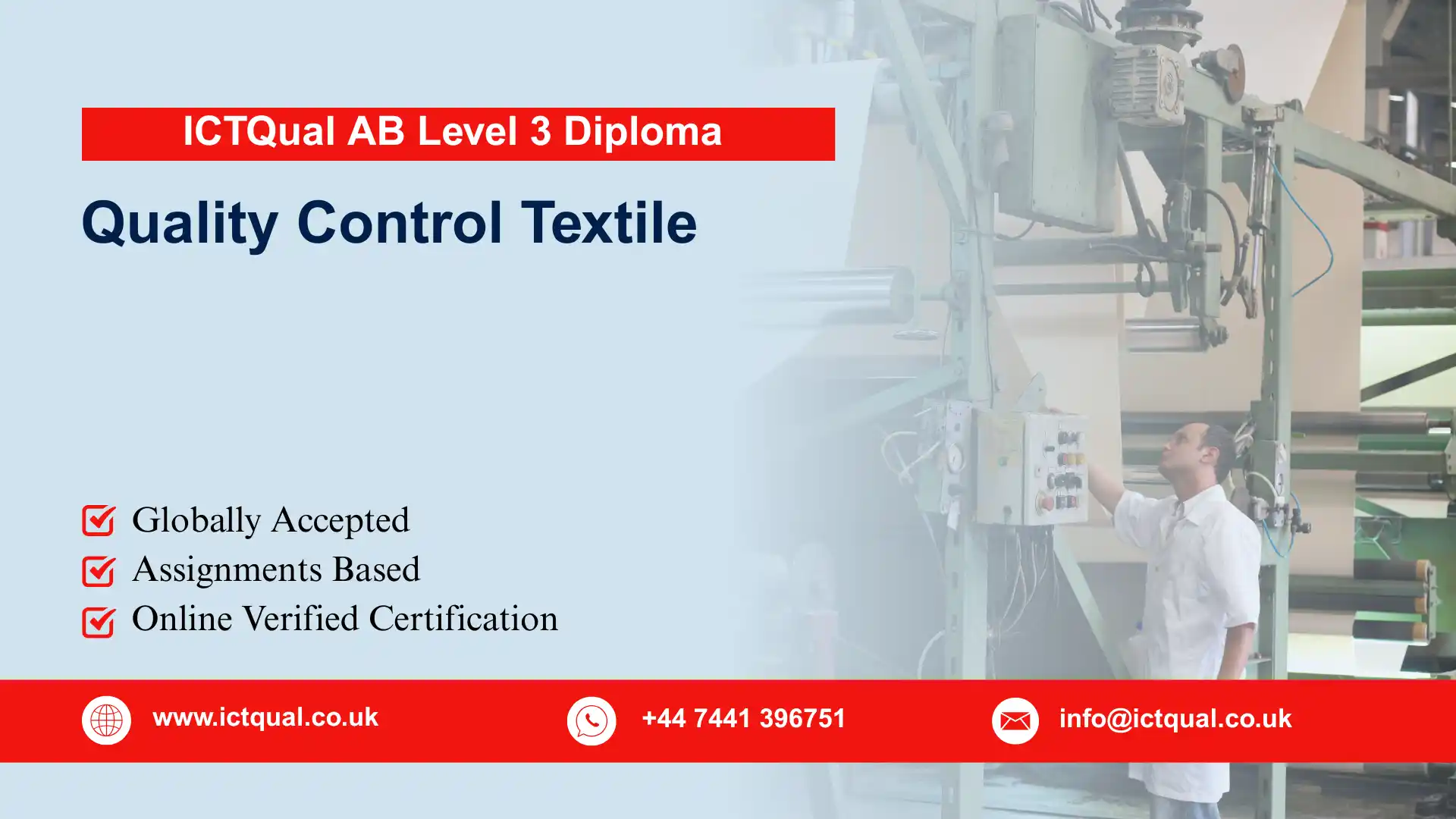
The ICTQual AB Level 3 Diploma in Quality Control Textile is a comprehensive qualification designed to build foundational expertise in maintaining and assessing textile product quality. This course introduces learners to the core principles of textile quality control, including inspection techniques, standards compliance, and defect detection. It focuses on key elements such as fiber characteristics, fabric testing, and process optimization, ensuring learners gain a well-rounded understanding of quality control in textile manufacturing environments.
Through a combination of theoretical knowledge and applied learning, students will explore practical aspects of quality assurance systems, laboratory testing procedures, and industry regulations relevant to textile production. The course emphasizes quality evaluation at different production stages—spinning, weaving, dyeing, and finishing—empowering learners to contribute effectively to quality improvement strategies in their organizations. Learners also develop problem-solving and documentation skills, which are essential for maintaining compliance and enhancing productivity.
This diploma is particularly valuable for individuals looking to enter or progress within the textile and apparel industries. It equips them with the tools to uphold international quality standards and ensure customer satisfaction in a competitive market. By completing this qualification, learners will be prepared to take on roles such as quality inspectors, production supervisors, or textile lab technicians, and play a vital role in delivering consistent, high-quality textile products.
Inspire College of Technologies UK is Directly Approved Training Centre of ICTQual AB
The ICTQual AB Level 3 Diploma in Quality Control Textile offers a structured and industry-focused curriculum tailored to the practical needs of the textile sector. The course covers fundamental aspects of textile science, material properties, and quality management systems. It guides learners through the inspection processes for raw materials, semi-finished goods, and finished textile products, ensuring they understand how to identify, analyze, and report defects effectively.
Learners will engage with various testing methodologies, including visual inspections, physical and chemical testing, and laboratory analysis. Emphasis is placed on industry standards such as ISO, AATCC, and ASTM, ensuring participants gain hands-on knowledge of international benchmarks in textile quality. The course also introduces learners to statistical quality control, documentation procedures, and corrective action plans necessary for continuous improvement.
Throughout the program, students develop the technical acumen and soft skills needed to thrive in quality assurance roles. The course prepares individuals to work across different departments—from production lines to quality labs—by building competence in communication, teamwork, and decision-making. Graduates of this diploma will be equipped to ensure consistent quality output and contribute to the competitive success of textile manufacturing operations.
This qualification, the ICTQual AB Level 3 Diploma in Quality Control Textile, consists of 6 mandatory units.
Mandatory Units
| Sr# | Unit Title | Level |
|---|---|---|
| 1 | Advanced Fabric Testing and Evaluation | 3 |
| 2 | Statistical Quality Control in Textiles | 3 |
| 3 | Process Control in Textile Manufacturing | 3 |
| 4 | Garment Inspection and Quality Auditing | 3 |
| 5 | Documentation and Record Keeping in QC | 3 |
| 6 | Communication and Team Coordination in QC | 3 |
The ICTQual AB Level 3 Diploma in Quality Control Textile is ideal for individuals who aspire to build a career in textile manufacturing and quality assurance. This course is suitable for:
- Beginners seeking foundational knowledge in textile quality control.
- Textile production workers aiming to upgrade their skills for quality-focused roles.
- Quality control inspectors and technicians who want formal certification.
- Supervisors and team leaders in textile processing units who wish to enhance their understanding of quality standards.
- Recent school leavers or vocational learners interested in joining the textile and apparel industry.
- Individuals planning to transition into quality management roles within textile companies.
This course supports career growth by equipping learners with the technical knowledge and practical tools needed to meet global quality expectations in textile production.
Learning Outcomes for the Study Units:
1. Advanced Fabric Testing and Evaluation
By the end of this unit, learners will be able to:
- Understand the principles and standards of advanced fabric testing techniques.
- Conduct physical and chemical testing on fabrics, including strength, shrinkage, colourfastness, and pilling.
- Analyze test results to evaluate fabric performance and compliance with quality standards.
- Interpret international testing methods (e.g., ASTM, ISO) applicable to textiles.
- Apply laboratory-based and in-line testing procedures in real-time quality control settings.
2. Statistical Quality Control in Textiles
By the end of this unit, learners will be able to:
- Understand the fundamentals of statistical quality control (SQC) in textile production.
- Apply statistical tools such as control charts, histograms, and process capability analysis to monitor production quality.
- Identify trends, deviations, and non-conformance in textile processes using data-driven approaches.
- Implement corrective actions based on statistical analysis to improve quality performance.
- Communicate findings and quality trends using visual and written reports.
3. Process Control in Textile Manufacturing
By the end of this unit, learners will be able to:
- Understand the key stages of textile manufacturing processes (spinning, weaving, dyeing, finishing, etc.).
- Monitor and control critical process parameters to maintain consistent quality output.
- Identify sources of variation and implement control measures to reduce defects.
- Apply process control tools and techniques to improve productivity and minimize rework.
- Collaborate with production teams to establish quality checkpoints and ensure process integrity.
4. Garment Inspection and Quality Auditing
By the end of this unit, learners will be able to:
- Understand the principles and procedures of garment inspection at various production stages.
- Identify common garment defects related to stitching, sizing, labeling, finishing, and appearance.
- Perform in-line and final inspections following industry standards and buyer requirements.
- Conduct internal quality audits and prepare audit checklists and reports.
- Recommend corrective and preventive actions based on audit findings.
5. Documentation and Record Keeping in Quality Control
By the end of this unit, learners will be able to:
- Recognize the importance of accurate documentation in maintaining textile quality standards.
- Prepare and maintain quality control reports, inspection records, test data, and audit logs.
- Use digital and manual record-keeping systems to ensure traceability and compliance.
- Organize and retrieve QC documents for audits, client verification, and internal reviews.
- Ensure confidentiality, accuracy, and consistency in quality documentation practices.
6. Communication and Team Coordination in Quality Control
By the end of this unit, learners will be able to:
- Develop effective communication skills for reporting quality issues and sharing feedback.
- Work collaboratively with production, inspection, and management teams to resolve quality concerns.
- Demonstrate conflict resolution and negotiation skills in a team environment.
- Participate in quality meetings and contribute to continuous improvement discussions.
- Prepare and deliver clear, concise verbal and written communication in a QC context.