
What is Lean Six Sigma? Everything You Need to Know in 2026
Improve quality, eliminate waste, reduce costs, and streamline business processes with the power of Lean Six Sigma.

Table of Contents
In today’s competitive business environment, organizations are constantly searching for smarter ways to improve efficiency, reduce errors, and increase customer satisfaction. This is where Lean Six Sigma becomes one of the most valuable business improvement methodologies in the world.
From manufacturing and healthcare to IT and finance, companies use Lean Six Sigma to optimize workflows, reduce waste, improve quality, and increase profitability. Major global organizations such as Toyota, Motorola, and General Electric have successfully implemented Lean Six Sigma principles to improve operational performance and customer experience.
What is Lean Six Sigma?
Lean Six Sigma is a data-driven methodology that combines Lean principles and Six Sigma techniques to improve business processes, reduce waste, minimize defects, and enhance overall efficiency.
Lean focuses on eliminating activities that do not add value, while Six Sigma focuses on reducing process variation and improving quality. Together, these approaches help organizations achieve operational excellence and customer satisfaction.
Simply put:
- Lean improves speed and efficiency
- Six Sigma improves accuracy and quality
- Lean Six Sigma combines both for maximum performance
Organizations use Lean Six Sigma to solve problems, improve workflows, reduce operational costs, and deliver better products and services.
Lean Six Sigma Explained Simply
Imagine a company that manufactures products but constantly faces delays, production errors, and customer complaints. Lean Six Sigma helps identify where problems occur, why they happen, and how to fix them permanently.
For example:
- Lean removes unnecessary steps that slow down production
- Six Sigma analyzes data to reduce defects and inconsistencies
The result is:
- Faster workflows
- Better quality
- Lower costs
- Happier customers
This methodology can be applied to almost every industry, including healthcare, construction, logistics, IT, education, and finance.
The History and Evolution of Lean Six Sigma
Origin of Lean Manufacturing
Lean methodology originated from the Toyota Production System in Japan. Toyota focused on eliminating waste and improving production efficiency.
Lean manufacturing introduced concepts such as:
- Continuous improvement
- Just-in-time production
- Waste reduction
- Process optimization
These principles transformed modern manufacturing practices worldwide.
The Birth of Six Sigma
Six Sigma was developed by Motorola in the 1980s to improve product quality and reduce defects.
The methodology uses statistical analysis and data-driven decision-making to improve process consistency.
Later, General Electric popularized Six Sigma globally under the leadership of Jack Welch.
How Lean and Six Sigma Combined
Organizations eventually realized that combining Lean efficiency with Six Sigma quality control produced even better results.
This combination created Lean Six Sigma — a methodology that focuses on both:
- Speed and efficiency
- Accuracy and quality
Today, Lean Six Sigma is used globally across multiple industries.
Why Lean Six Sigma Matters in 2026
Businesses in 2026 face increasing competition, rising customer expectations, digital transformation, and operational challenges.
Lean Six Sigma helps organizations:
- Reduce operational costs
- Improve productivity
- Enhance customer satisfaction
- Increase profitability
- Streamline workflows
- Improve decision-making
As automation and AI continue transforming industries, companies increasingly rely on process improvement frameworks to remain competitive.
Difference Between Lean and Six Sigma
| Feature | Lean | Six Sigma |
|---|---|---|
| Main Focus | Waste Reduction | Defect Reduction |
| Goal | Improve Speed | Improve Quality |
| Approach | Process Efficiency | Statistical Analysis |
| Key Objective | Eliminate Non-Value Activities | Reduce Variation |
| Best For | Workflow Optimization | Quality Control |
Lean focuses on efficiency, while Six Sigma focuses on consistency and precision.
Lean Six Sigma combines both methodologies into a single framework.
How Lean Six Sigma Works
Lean Six Sigma works by identifying inefficiencies, analyzing process problems, and implementing long-term improvements.
Organizations use structured methodologies to:
- Collect process data
- Analyze root causes
- Implement solutions
- Monitor improvements
The methodology promotes continuous improvement throughout the organization.
The 5 Phases of Lean Six Sigma (DMAIC)
The DMAIC framework is one of the most important components of Lean Six Sigma.
Define Phase
The Define phase identifies:
- Business problems
- Customer requirements
- Project goals
- Process improvement objectives
This phase establishes a clear project scope and direction.
Measure Phase
The Measure phase focuses on collecting accurate data about current process performance.
Organizations analyze:
- Process efficiency
- Error rates
- Defect frequency
- Workflow delays
Reliable data is essential for effective decision-making.
Analyze Phase
During the Analyze phase, teams identify the root causes of problems and inefficiencies.
Common analysis tools include:
- Fishbone diagrams
- Pareto charts
- Root cause analysis
- Process mapping
The goal is to understand why problems occur.
Improve Phase
The Improve phase involves implementing solutions to optimize processes and eliminate inefficiencies.
Examples include:
- Workflow redesign
- Automation
- Standardization
- Employee training
This phase focuses on achieving measurable improvements.
Control Phase
The Control phase ensures that improvements are maintained over time.
Organizations use:
- Performance monitoring
- Process controls
- Standard operating procedures
- Regular audits
The objective is to prevent problems from returning.
Core Principles of Lean Six Sigma
Customer Focus
- Lean Six Sigma prioritizes customer satisfaction by improving product and service quality.
- Organizations analyze customer expectations and align processes accordingly.
Continuous Improvement
- Continuous improvement is a key principle of Lean Six Sigma.
- Businesses regularly evaluate and improve operations to maintain efficiency and competitiveness.
Employee Involvement
- Employees play a critical role in identifying problems and improving processes.
- Successful organizations encourage collaboration and innovation at every level.
Data-Driven Decision Making
- Lean Six Sigma relies heavily on measurable data instead of assumptions.
- This improves accuracy and reduces decision-making risks.
Lean Six Sigma Tools and Techniques
Several tools support Lean Six Sigma implementation.
SIPOC Diagram
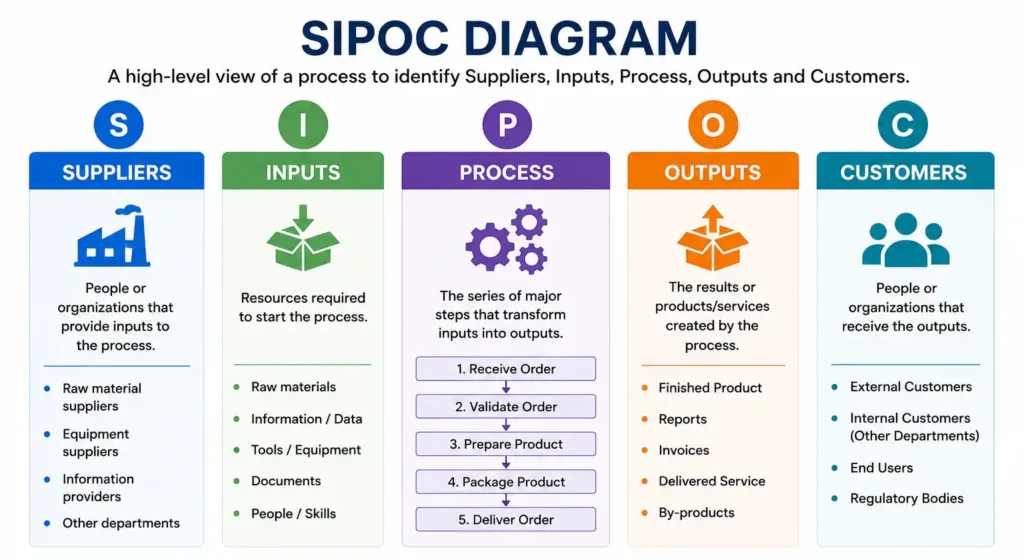
A SIPOC Diagram is a visual process mapping tool used in Lean Six Sigma to understand how a business process works from start to finish. It gives teams a high-level overview of a process before they begin analyzing problems or implementing improvements.
The word SIPOC stands for:
- S – Suppliers
- I – Inputs
- P – Process
- O – Outputs
- C – Customers
This framework helps organizations clearly identify:
- who provides resources,
- what is needed for the process,
- how the process works,
- what results are produced,
- and who receives the final outcome.
SIPOC diagrams are commonly used during the Define Phase of the DMAIC methodology because they help teams understand the complete process before making improvements.
Fishbone Diagram
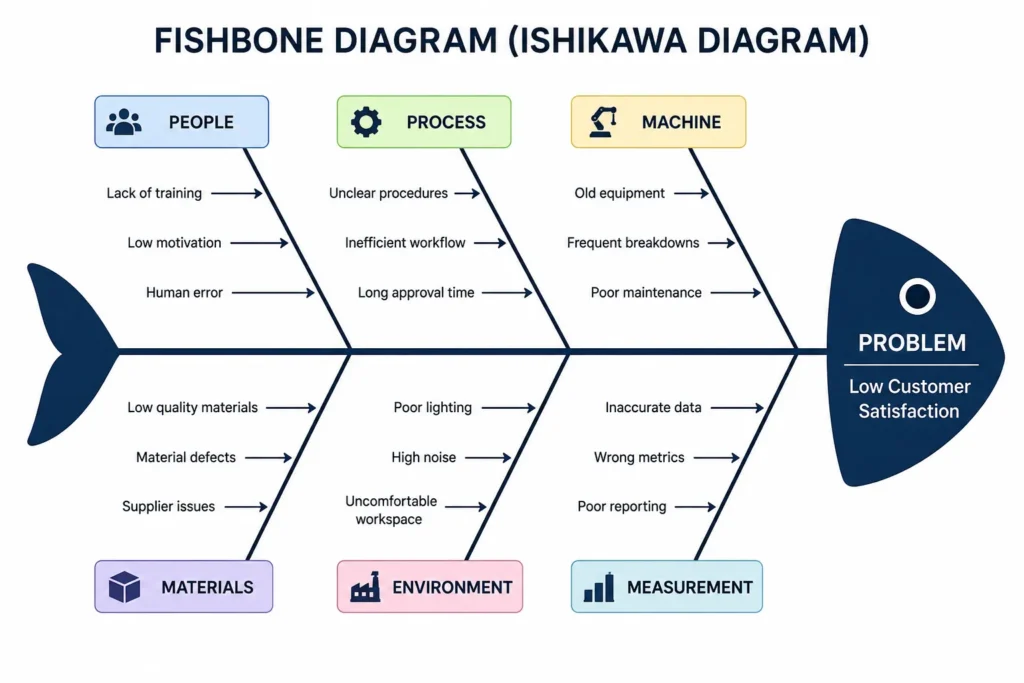
A Fishbone Diagram is a problem-solving tool used in Lean Six Sigma to identify the root causes of a problem. It helps teams visually organize possible causes into categories so they can better understand why an issue is happening.
The diagram is called a Fishbone Diagram because its structure looks similar to the skeleton of a fish:
- the “head” represents the main problem,
- and the “bones” represent different categories of possible causes.
It is also known as the Ishikawa Diagram, named after Kaoru Ishikawa, who developed this method to improve quality management and problem-solving processes.
How a Fishbone Diagram Works
The diagram starts with a clearly defined problem statement written at the “head” of the fish.
Example problems:
- Late product delivery
- High defect rates
- Customer complaints
- Poor employee productivity
- Machine breakdowns
Then, major categories of possible causes are connected to the main line of the diagram like fish bones.
Teams brainstorm possible causes under each category.
Pareto Chart
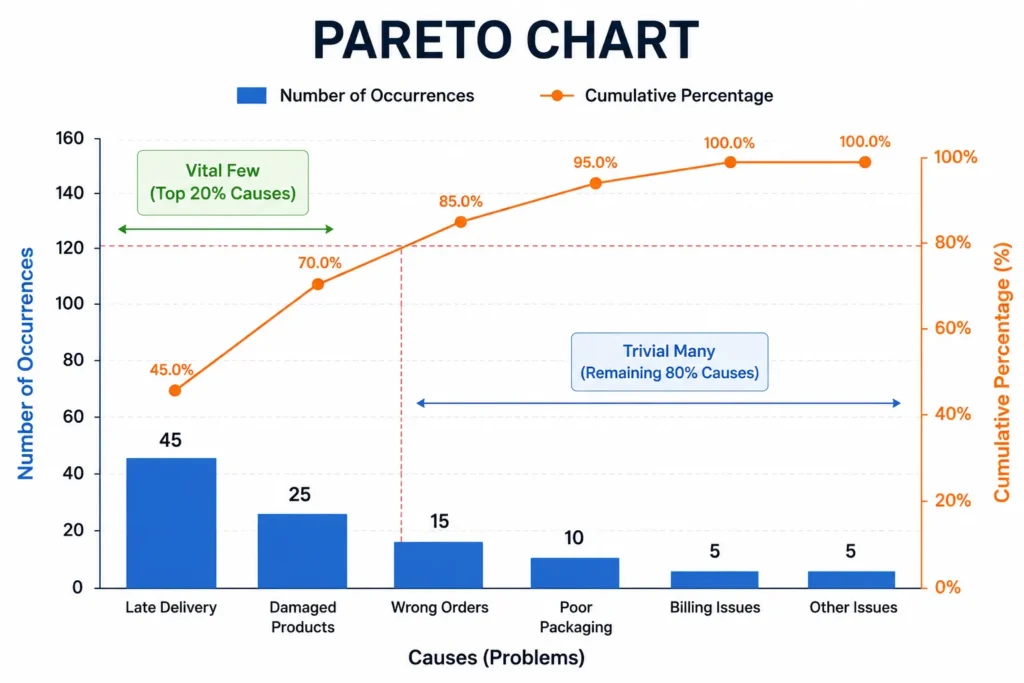
A Pareto Chart is one of the most widely used tools in Lean Six Sigma for identifying the most significant problems affecting a process or business operation.
It combines:
- a bar chart, which shows the frequency of problems,
- and a line graph, which shows the cumulative impact of those problems.
The main purpose of a Pareto Chart is to help organizations focus on the issues that create the biggest impact instead of wasting time on less important problems.
What is the Pareto Principle?
The Pareto Chart is based on the Pareto Principle, also known as the 80/20 Rule.
The principle states that:
Approximately 80% of problems are often caused by 20% of the causes.
This means that a small number of issues usually create the majority of business problems.
For example:
- 20% of defects may cause 80% of customer complaints.
- 20% of products may generate 80% of sales.
- 20% of process errors may create 80% of delays.
The idea was developed by Vilfredo Pareto, who observed that a small percentage of factors often produce the majority of results.
How a Pareto Chart Works
A Pareto Chart organizes problems from the most frequent to the least frequent.
The chart usually contains:
Bars
The bars represent different categories of problems.
The taller the bar:
- the more frequently the problem occurs.
Cumulative Percentage Line
The line graph shows the combined impact of all categories as percentages.
This helps teams identify where most of the problems originate.
Value Stream Mapping
Value Stream Mapping visualizes workflows and identifies areas of waste.
This helps organizations improve operational efficiency.
5 Whys Technique
- The 5 Whys method identifies root causes by repeatedly asking “Why?”
- It is simple but highly effective for problem-solving.
Lean Six Sigma Belt Levels Explained
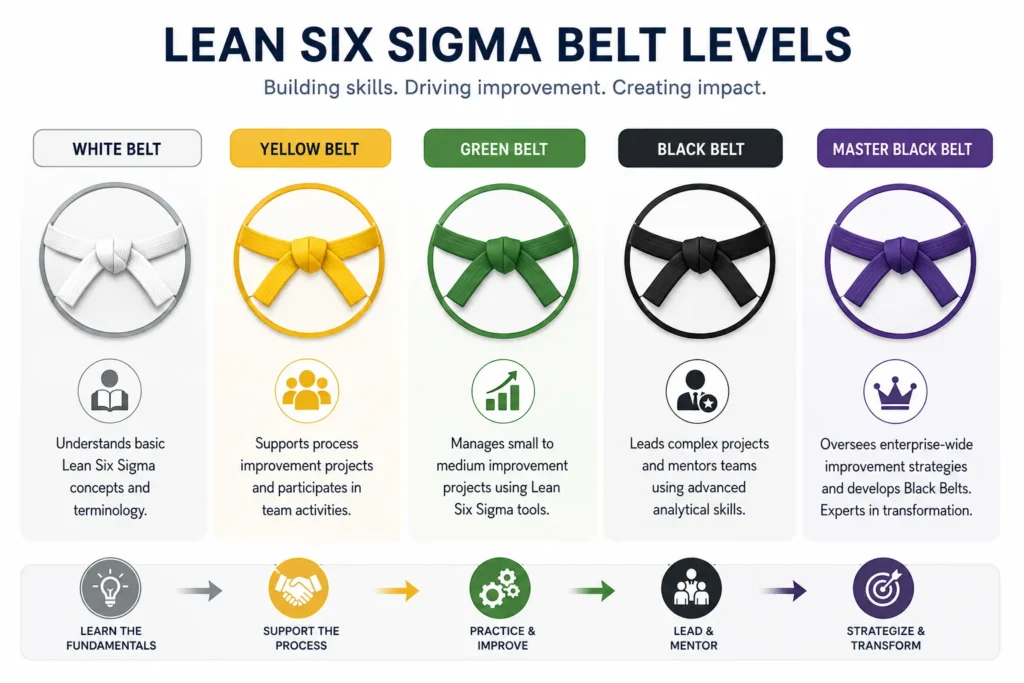
Lean Six Sigma certifications are divided into different belt levels, similar to martial arts rankings. Each belt represents a different level of knowledge, experience, leadership responsibility, and problem-solving capability.
As professionals progress through the belt system, they gain deeper expertise in:
- process improvement,
- data analysis,
- quality management,
- project leadership,
- and operational efficiency.
These certifications help individuals develop valuable business and analytical skills that are widely recognized across industries.
White Belt
Foundation Level of Lean Six Sigma
White Belt is the beginner level in Lean Six Sigma. It introduces individuals to the basic concepts, terminology, and principles of process improvement.
Professionals at this level gain a general understanding of:
- Lean Six Sigma methodology,
- waste reduction,
- continuous improvement,
- and basic problem-solving approaches.
White Belts usually do not lead projects directly, but they understand how Lean Six Sigma works within an organization and can support improvement initiatives.
Key Responsibilities
- Learn basic Lean Six Sigma concepts
- Understand process improvement terminology
- Support team discussions and improvement culture
Best For
- Beginners
- Employees new to Lean Six Sigma
- Individuals exploring process improvement careers
Yellow Belt
Entry-Level Project Participation
Yellow Belt professionals have a deeper understanding of Lean Six Sigma principles and actively participate in improvement projects.
They support project teams by:
- collecting data,
- identifying process problems,
- assisting with workflow improvements,
- and contributing ideas during analysis sessions.
Yellow Belts often work under the guidance of Green Belts or Black Belts.
Skills Developed
- Basic root cause analysis
- Process mapping
- Problem-solving techniques
- Team collaboration
Key Responsibilities
- Support process improvement activities
- Assist in data collection and analysis
- Participate in Lean Six Sigma projects
Best For
- Team members
- Supervisors
- Operational staff
- Entry-level managers
Green Belt
Project Management and Process Improvement
Green Belts are trained to manage small-to-medium Lean Six Sigma projects independently. They possess a strong understanding of Lean Six Sigma tools, DMAIC methodology, and process analysis techniques.
At this level, professionals focus on:
- improving operational efficiency,
- reducing defects,
- analyzing performance data,
- and solving business problems systematically.
Green Belts typically work on improvement projects alongside their regular job responsibilities.
Skills Developed
- DMAIC implementation
- Statistical analysis
- Root cause analysis
- Process optimization
- Performance measurement
Key Responsibilities
- Lead small improvement projects
- Analyze business processes
- Identify operational inefficiencies
- Implement process improvements
Best For
- Team leaders
- Project coordinators
- Department supervisors
- Process improvement professionals
Black Belt
Advanced Leadership and Strategic Improvement
Black Belt is an advanced Lean Six Sigma certification focused on leadership, strategic problem-solving, and complex project management.
Black Belts lead major organizational improvement initiatives and mentor Green Belts and project teams. They use advanced analytical and statistical methods to solve high-impact business problems.
Professionals at this level are experts in:
- data-driven decision-making,
- process redesign,
- change management,
- and operational excellence.
Skills Developed
- Advanced statistical analysis
- Leadership and team management
- Strategic planning
- Complex problem-solving
- Change management
Key Responsibilities
- Lead enterprise-level improvement projects
- Mentor Green Belts and project teams
- Analyze complex operational issues
- Improve organizational performance
Best For
- Senior managers
- Quality managers
- Operations leaders
- Continuous improvement specialists
Master Black Belt
Highest Level of Lean Six Sigma Expertise
Master Black Belt is the highest certification level in Lean Six Sigma. These professionals are organizational experts responsible for developing enterprise-wide improvement strategies and mentoring Black Belts.
Master Black Belts focus on:
- long-term business transformation,
- organizational strategy,
- advanced analytics,
- and leadership development.
They play a major role in building a culture of continuous improvement across the organization.
Skills Developed
- Enterprise strategy development
- Organizational transformation
- Advanced mentoring and coaching
- Executive leadership
- Business optimization
Key Responsibilities
- Train and mentor Black Belts
- Develop company-wide improvement programs
- Align Lean Six Sigma with business goals
- Lead large-scale transformation initiatives
Best For
- Executive leaders
- Senior consultants
- Organizational transformation experts
- Process excellence directors
Which Lean Six Sigma Belt is Best?
The best belt level depends on your career goals, industry experience, and professional responsibilities.
| Belt Level | Best For |
|---|---|
| White Belt | Beginners |
| Yellow Belt | Team Support Roles |
| Green Belt | Project Leaders |
| Black Belt | Senior Improvement Managers |
| Master Black Belt | Organizational Leaders |
Benefits of Lean Six Sigma
Improved Quality
Organizations reduce defects and improve product consistency.
Lower Costs
Lean Six Sigma reduces waste, rework, and operational inefficiencies.
Increased Efficiency
Processes become faster, smoother, and more productive.
Better Customer Satisfaction
Improved quality and reliability lead to better customer experiences.
Stronger Business Performance
Organizations gain competitive advantages through operational excellence.
Industries That Use Lean Six Sigma
Manufacturing
Manufacturers use Lean Six Sigma to improve production efficiency and reduce defects.
Healthcare
Hospitals and healthcare providers improve patient care and operational workflows.
Information Technology
IT companies optimize software development and service delivery processes.
Construction
Construction firms reduce delays, material waste, and project inefficiencies.
Logistics and Supply Chain
Supply chain organizations improve inventory management and transportation efficiency.
Lean Six Sigma Certification Guide
Lean Six Sigma certifications help professionals develop valuable business improvement skills.
Certification programs teach:
- Process optimization
- Problem-solving
- Data analysis
- Leadership skills
Many organizations prefer certified professionals for management and operational roles.
Is Lean Six Sigma Worth It in 2026?
Yes. Lean Six Sigma remains highly valuable in 2026 because organizations increasingly prioritize efficiency, quality, and cost reduction.
Benefits include:
- Better career opportunities
- Higher salaries
- Strong analytical skills
- Leadership development
- Increased employability
Professionals with Lean Six Sigma expertise are востребованы across multiple industries.
Common Lean Six Sigma Mistakes
Poor Training
Insufficient employee training often causes project failures.
Lack of Leadership Support
Without management support, improvement initiatives struggle to succeed.
Ignoring Customer Needs
Process improvements should always align with customer expectations.
Inaccurate Data Collection
Poor data quality can lead to ineffective decisions and incorrect analysis.
Real-World Lean Six Sigma Examples
Many global companies successfully use Lean Six Sigma.
For example:
- Manufacturing companies reduce production defects
- Hospitals reduce patient waiting times
- Logistics firms improve delivery efficiency
- IT companies streamline software development
Lean Six Sigma helps organizations solve real business challenges systematically.
Future Trends in Lean Six Sigma
Lean Six Sigma continues evolving alongside modern technologies.
Key future trends include:
- AI-powered process optimization
- Automation and robotics
- Predictive analytics
- Digital transformation
- Smart manufacturing
- Data-driven business intelligence
Organizations integrating Lean Six Sigma with advanced technologies will gain stronger competitive advantages.
Lean Six Sigma continues to be one of the most effective frameworks for improving quality, efficiency, and operational performance in 2026.
By combining Lean efficiency with Six Sigma quality control, organizations can reduce waste, eliminate defects, optimize workflows, and improve customer satisfaction.
Whether you are a business owner, manager, student, or working professional, learning Lean Six Sigma can help you develop valuable problem-solving and leadership skills that remain highly relevant across industries worldwide.
Frequently Asked Questions About Lean Six Sigma
What is Lean Six Sigma?
Lean Six Sigma is a business improvement methodology that combines Lean principles and Six Sigma techniques to reduce waste, improve quality, and increase operational efficiency.
What is the difference between Lean and Six Sigma?
Lean focuses on eliminating waste and improving process speed, while Six Sigma focuses on reducing defects and process variation. Lean Six Sigma combines both approaches for better efficiency and quality.
What is DMAIC in Lean Six Sigma?
DMAIC is a structured problem-solving framework used in Lean Six Sigma projects. It stands for Define, Measure, Analyze, Improve, and Control.
What Skills Do Lean Six Sigma Professionals Need?
Lean Six Sigma professionals need strong analytical and problem-solving skills to identify issues and improve business processes effectively. They should also have good leadership and communication abilities to work with teams, manage projects, and support continuous process improvement within an organization.
Is Lean Six Sigma Difficult to Learn?
Basic Lean Six Sigma concepts are relatively easy to understand. Advanced certifications such as Black Belt may require deeper statistical and analytical knowledge.
What Career Opportunities Are Available with Lean Six Sigma Certification?
Lean Six Sigma certifications can help professionals build careers in operations management, quality assurance, project management, process improvement, manufacturing, healthcare management, and business consulting. These certifications are highly valued because they demonstrate strong problem-solving, analytical, and process optimization skills.