
What is Environmental Engineering?
Environmental engineering is one of the most dynamic and rapidly growing fields in the 21st century. It is a multidisciplinary discipline that combines principles of engineering, science, and technology to address some of the most pressing challenges facing our planet. By applying scientific knowledge, engineering design, and innovative technologies, environmental engineers work to protect natural resources, safeguard public health, and promote sustainable development.
Environmental engineers tackle critical issues across multiple domains:
- Air and Water Pollution Control: Designing systems to reduce industrial emissions, improve air quality, and treat contaminated water before it reaches rivers, lakes, or communities.
- Waste Management: Developing methods to handle municipal, industrial, and hazardous waste efficiently while promoting recycling and minimizing landfill impact.
- Environmental Compliance: Ensuring that industries, construction projects, and municipalities comply with local and international environmental laws and standards.
- Sustainability Projects: Integrating sustainable solutions into urban planning, industrial processes, and infrastructure development to reduce ecological footprints.
In today’s world, environmental challenges are becoming increasingly complex. Climate change, rapid urbanization, industrialization, and resource depletion are creating urgent demand for professionals who can design practical solutions while balancing economic, social, and environmental needs. Environmental engineers are at the forefront of these efforts, providing technical expertise and strategic insight to create cleaner, safer, and more sustainable communities.
Why Environmental Engineering is Important?
Environmental engineering is one of the most critical fields of modern engineering because it directly addresses the challenges that threaten human health, ecosystems, and global sustainability. As industrialization, urbanization, and climate change accelerate, the role of environmental engineers becomes increasingly vital.
Here’s why this field matters:
1. Designing Pollution Control Systems
Environmental engineers develop and implement advanced systems to control pollution in air, water, and soil. From wastewater treatment plants to air filtration systems in industrial facilities, these engineers ensure that harmful emissions are minimized, protecting both the environment and human health.
- Air pollution control: Designing scrubbers, filters, and emission monitoring systems for industries
- Water pollution control: Creating treatment plants and systems to remove contaminants before water is released back into rivers or reused
- Soil contamination control: Developing solutions to prevent heavy metals, chemicals, and industrial by-products from degrading land quality
2. Managing Industrial and Municipal Waste
Environmental engineers play a key role in waste management, transforming potential hazards into sustainable resources. This includes recycling programs, landfill management, and industrial waste treatment. Proper waste management reduces environmental degradation and promotes a circular economy where materials are reused, not wasted.
- Implementing recycling and composting initiatives
- Designing safe landfill sites and hazardous waste containment
- Reducing industrial waste through efficient production processes
3. Ensuring Regulatory Compliance
Environmental engineers help organizations adhere to local, national, and international environmental laws. By ensuring compliance, they prevent environmental disasters, legal penalties, and reputational damage, while promoting responsible industrial practices.
- Monitoring compliance with environmental standards (ISO, EPA, HSE regulations)
- Preparing environmental reports and audits for industries
- Guiding policy implementation for sustainable industrial practices
4. Supporting Sustainable Development
Environmental engineers contribute to sustainable growth by designing infrastructure and projects that meet today’s needs without compromising future generations. They balance industrial development with ecological protection, ensuring that urban, industrial, and natural ecosystems coexist harmoniously.
- Planning green buildings and eco-friendly urban developments
- Restoring degraded ecosystems and natural habitats
- Incorporating sustainable materials and energy-efficient systems into engineering projects
5. Driving Innovation in Renewable Energy and Green Technology
The field is at the forefront of innovations that fight climate change. Environmental engineers develop solutions in renewable energy, environmental monitoring, and green technology, making industries more efficient and less harmful to the planet.
- Designing solar, wind, and bioenergy systems
- Implementing smart environmental monitoring solutions
- Researching emerging green technologies for waste reduction and energy efficiency
Environmental Engineering Programs: A Clear Comparison for Your Career Path
| Feature / Focus Area | Beginner-Level Programs | Professional-Level Programs | Advanced / Experience-Based Programs |
|---|---|---|---|
| Target Audience | Fresh graduates or students entering environmental engineering | Mid-career professionals or HSE specialists | Experienced professionals seeking recognition or leadership roles |
| Program Focus | Fundamentals of environmental engineering, air & water pollution, waste management, sustainability basics | Advanced environmental management, strategic planning, leadership, Environmental Impact Assessment (EIA), regulatory compliance | Experience-based skills validation, advanced sustainability projects, research, global standards |
| Practical Component | Hands-on workshops, lab exercises, small field projects | Case studies, capstone research projects, field assessments | Real-world experience validation, applied projects, problem-solving exercises |
| Core Skills Developed | Pollution control, waste management, environmental monitoring, basic sustainability design | Strategic planning, advanced EIA, environmental risk assessment, compliance management | Leadership, project management, advanced sustainability solutions, policy guidance |
| Certifications / Recognition | Diploma-level certification | Professional diplomas / Level 8 equivalent | Experience-based or globally recognized certification |
| Career Outcome | Entry-level roles: Environmental Technician, Junior Engineer, Assistant Consultant | Mid-level roles: Environmental Engineer, HSE Officer, Environmental Consultant | Senior / Leadership roles: Sustainability Manager, Director of Environmental Compliance, Policy Advisor |
| Time / Duration | Short-term: 6–12 months | Medium-term: 12–18 months | Flexible: 6–24 months depending on prior experience |
| Industry Relevance | Provides foundational knowledge for entry into environmental, industrial, or municipal roles | Prepares professionals for consultancy, industrial compliance, or managerial roles | Recognized for leadership, strategic positions, and global mobility |
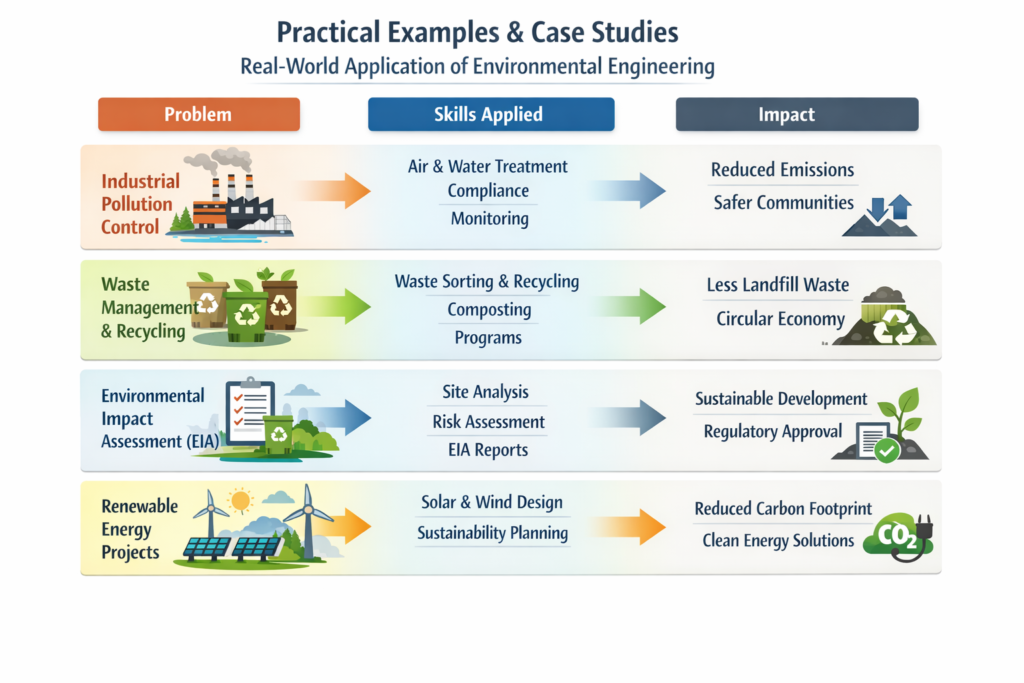
Real-World Application of Environmental Engineering
Environmental engineering is not just about theory; its true value lies in real-world problem solving. Practical examples and case studies help students and professionals understand how environmental concepts are applied, bridging the gap between classroom learning and industry needs.
1. Pollution Control in Industrial Plants
- Example: Designing air and water treatment systems for a manufacturing facility to reduce harmful emissions.
- Skills Applied: Air quality monitoring, wastewater treatment, chemical analysis, and environmental compliance.
- Impact: Reduces environmental damage, ensures regulatory compliance, and protects community health.
2. Sustainable Waste Management Projects
- Example: Implementing a recycling and composting program for municipal solid waste in urban areas.
- Skills Applied: Waste segregation, landfill management, recycling processes, and public awareness campaigns.
- Impact: Minimizes landfill usage, promotes a circular economy, and encourages sustainable living practices.
3. Environmental Impact Assessments (EIA)
- Example: Conducting an EIA for a new construction or infrastructure project.
- Skills Applied: Data collection, environmental modeling, risk assessment, and reporting.
- Impact: Identifies potential ecological risks, informs sustainable project design, and ensures compliance with environmental regulations.
4. Renewable Energy & Sustainability Solutions
- Example: Designing and evaluating solar, wind, or bioenergy projects for industrial or community use.
- Skills Applied: Renewable energy system design, sustainability assessment, lifecycle analysis.
- Impact: Promotes clean energy adoption, reduces carbon footprint, and supports global climate goals.
5. Disaster Mitigation & Environmental Safety
- Example: Developing flood management strategies or chemical spill response plans for industrial sites.
- Skills Applied: Risk analysis, emergency planning, environmental modeling, and community safety strategies.
- Impact: Protects ecosystems and human lives, ensures faster response to environmental hazards, and strengthens resilience.
Learning Roadmap – From Beginner to Advanced in Environmental Engineering
A well-designed, step-by-step learning roadmap is the key to building a successful career in environmental engineering. This roadmap serves as a comprehensive guide, taking you from entry-level programs all the way to advanced professional qualifications, ensuring you gain the expertise and credibility needed to thrive in the global environmental sector.
1. Beginner Level (Foundational Skills – Level 3)
Focus: Establish a strong base in environmental engineering principles.
Key Learning Areas:
- Fundamentals of air, water, and soil pollution
- Basics of waste management and recycling systems
- Introduction to sustainability and environmental planning
- Overview of local and international environmental regulations
Practical Exposure:
- Hands-on lab exercises
- Workshops and interactive learning
- Field assignments to observe real-world applications
Career Outcome:
- Prepares learners for entry-level roles such as Environmental Technician, Junior Engineer, or Assistant Consultant
2. Intermediate Level (Applied Skills – Level 4–5)
Focus: Develop practical technical skills and problem-solving capabilities.
Key Learning Areas:
- Environmental monitoring and data analysis techniques
- Pollution control technologies and industrial processes
- Environmental Impact Assessment (EIA) methods
- Regulatory compliance and environmental reporting
Practical Exposure:
- Internship programs in industries or environmental agencies
- Case studies and scenario-based learning
- Project-based assignments to apply theoretical knowledge
Career Outcome:
- Prepares learners for mid-level roles such as Environmental Engineer, HSE Officer, or Environmental Analyst
3. Advanced Level (Professional & Leadership Skills – Level 6–7)
Focus: Specialize in advanced topics, strategic planning, and leadership development.
Key Learning Areas:
- Advanced Environmental Impact Assessment (EIA) and risk assessment
- Sustainable design for industrial, urban, and natural ecosystems
- Environmental management systems (ISO 14001 compliance)
- Project management and integration of green technologies
Practical Exposure:
- Capstone projects and applied research
- Real-world problem-solving initiatives
- Strategic environmental planning exercises
Career Outcome:
- Prepares learners for senior roles such as Sustainability Manager, Environmental Consultant, or Senior HSE Officer
4. Expert Level (Strategic & Global Recognition – Level 8)
Focus: Attain leadership skills, research expertise, and internationally recognized accreditation.
Key Learning Areas:
- Policy development and global environmental standards
- Strategic sustainability initiatives and consultancy
- Advanced environmental project planning and implementation
- Innovation in renewable energy and climate resilience solutions
Practical Exposure:
- Large-scale environmental projects
- Strategic consultancy assignments
- Experience-based skill validation for international recognition
Career Outcome:
- Prepares professionals for executive and global roles, including Director of Environmental Compliance, Policy Advisor, or Research Lead.