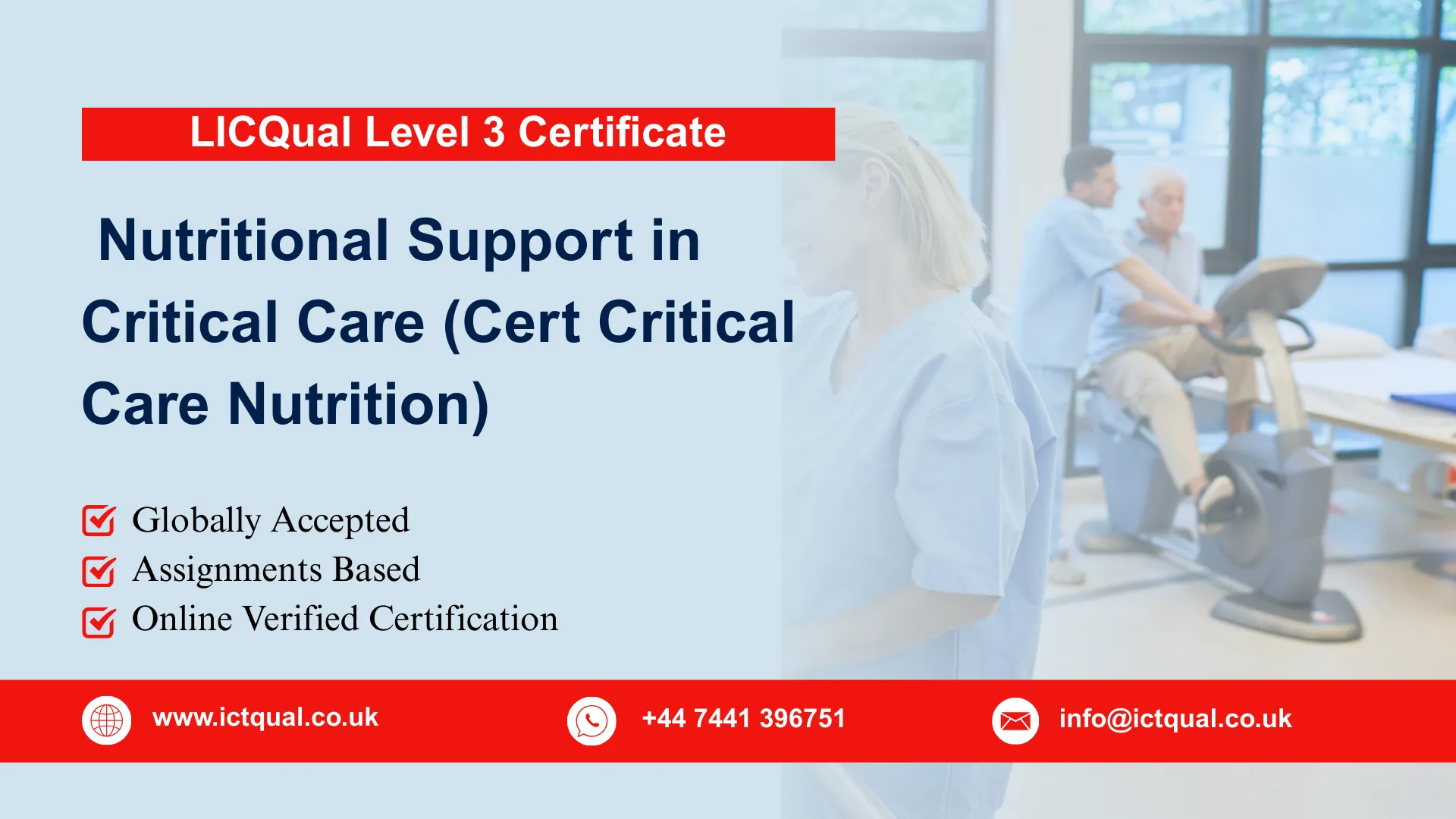
LICQual Level 3 Certificate in Nutritional Support in Critical Care
In critical care settings, every decision can mean the difference between recovery and decline. Among the most vital yet often overlooked aspects of treatment is nutrition. Patients in intensive care face unique challenges—trauma, surgery, sepsis, or organ failure that demand precise nutritional strategies to stabilize and support recovery. Nutritional support in critical care is therefore not just a supplement to treatment; it is a cornerstone of survival.
The importance of nutritional support in critical care lies in its ability to reduce complications, strengthen immunity, and accelerate healing. Proper nutrition can minimize muscle wasting, improve wound healing, and enhance the body’s ability to fight infection. It is a science that requires both clinical knowledge and practical application, ensuring that patients receive the right nutrients at the right time.
The LICQual Level 3 Certificate in Nutritional Support in Critical Care (Cert Critical Care Nutrition) emphasizes the significance of this discipline in modern healthcare. For learners, engaging with nutritional support in critical care is more than academic.it is an opportunity to contribute to lifesaving interventions, strengthen professional expertise, and play a vital role in advancing patient care.
Program Outline
The LICQual Level 3 Certificate in Nutritional Support in Critical Care (Cert Critical Care Nutrition) is a structured qualification designed to provide learners with specialized expertise in managing nutrition for critically ill patients. Comprising 6 units and worth 24 credits, the program introduces learners to essential areas such as metabolic response to illness, dietary assessment in intensive care, patient safety frameworks, compliance with international standards, and ethical considerations in nutritional support in critical care.
Learners are trained to apply evidence‑based approaches, design tailored nutrition plans, and manage interventions effectively. The course emphasizes practical skills that prepare graduates to meet the demands of hospitals, intensive care units, and emergency healthcare services.
This internationally recognized qualification opens doors to diverse opportunities in healthcare institutions, wellness organizations, and research facilities. For anyone aspiring to build a career in nutritional support in critical care, the program serves as a valuable credential that combines scientific knowledge with practical application.
Unit Structure
| Qualification | Unit Title | Credits | GLH |
| LICQ2201018-1 | Introduction to Nutritional Support in Critical Care | 4 | 20 |
| LICQ2201018-2 | Physiological and Metabolic Changes in Critical Illness | 4 | 20 |
| LICQ2201018-3 | Assessment and Monitoring of Nutritional Status | 4 | 20 |
| LICQ2201018-4 | Enteral and Parenteral Nutrition Support | 4 | 20 |
| LICQ2201018-5 | Clinical Decision-Making and Intervention Strategies | 4 | 20 |
| LICQ2201018-6 | Professional Practice in Critical Care Nutrition | 4 | 20 |
Who Can Benefit
The LICQual Level 3 Certificate in Nutritional Support in Critical Care (Cert Critical Care Nutrition) is designed for individuals who want to specialize in nutrition for critically ill patients. This program is particularly valuable for those who aim to address challenges such as malnutrition, metabolic disorders, and patient safety in intensive care. It helps learners strengthen their expertise, improve employability, and prepare for roles where nutritional support in critical care is central to healthcare delivery.
Ideal Learners
- Students aspiring to enter healthcare sciences with a focus on critical care nutrition.
- Entry‑level professionals seeking structured training in nutritional support in critical care.
- Nursing assistants wanting to expand knowledge of diet and patient safety.
- Community health workers preparing for responsibilities in hospital nutrition services.
- Hospital support staff aiming to strengthen skills in compliance and dietary care.
- Healthcare professionals transitioning into critical care nutrition roles.
- Career changers interested in wellness, diet planning, and healthcare practice.
- Ambitious learners who want to develop practical skills for nutritional support in critical care careers.
What You’ll Be Able to Do
Unit 1: Introduction to Nutritional Support in Critical Care
By the end of this unit, learners will be able to
- Explain the principles and importance of nutritional support in critical care
- Analyse the role of healthcare professionals in delivering nutrition interventions in high-dependency and intensive care settings
- Evaluate the impact of malnutrition on patient recovery and outcomes
- Identify key factors influencing effective nutritional care in critically ill patients
Unit 2: Physiological and Metabolic Changes in Critical Illness
By the end of this unit, learners will be able to
- Describe the physiological and metabolic responses to critical illness
- Analyse how illness and stress affect energy requirements and nutrient metabolism
- Evaluate the implications of metabolic changes for nutritional assessment and intervention
- Apply knowledge of physiological processes to inform patient care decisions
Unit 3: Assessment and Monitoring of Nutritional Status
By the end of this unit, learners will be able to
- Conduct comprehensive assessments of critically ill patients’ nutritional status
- Interpret clinical, biochemical, and anthropometric data to inform care planning
- Identify patients at risk of malnutrition or nutrient deficiencies
- Monitor and evaluate the effectiveness of nutritional interventions
Unit 4: Enteral and Parenteral Nutrition Support
By the end of this unit, learners will be able to
- Explain the principles, indications, and contraindications of enteral and parenteral nutrition
- Select appropriate nutrition formulas and delivery methods for individual patients
- Manage potential complications associated with nutritional support
- Apply evidence-based practices to optimise nutrition delivery in critical care
Unit 5: Clinical Decision-Making and Intervention Strategies
By the end of this unit, learners will be able to
- Develop personalised nutritional intervention plans for critically ill patients
- Apply clinical reasoning and evidence-based practice to support decision-making
- Evaluate the effectiveness of interventions and adjust care plans as needed
- Integrate multidisciplinary input to enhance patient outcomes
Unit 6: Professional Practice in Critical Care Nutrition
By the end of this unit, learners will be able to
- Demonstrate professional, ethical, and legal responsibilities in critical care nutrition practice
- Communicate effectively with patients, families, and multidisciplinary teams
- Apply evidence-based practice to support high-quality patient care
- Engage in Continuing Professional Development (CPD) to enhance knowledge and competence