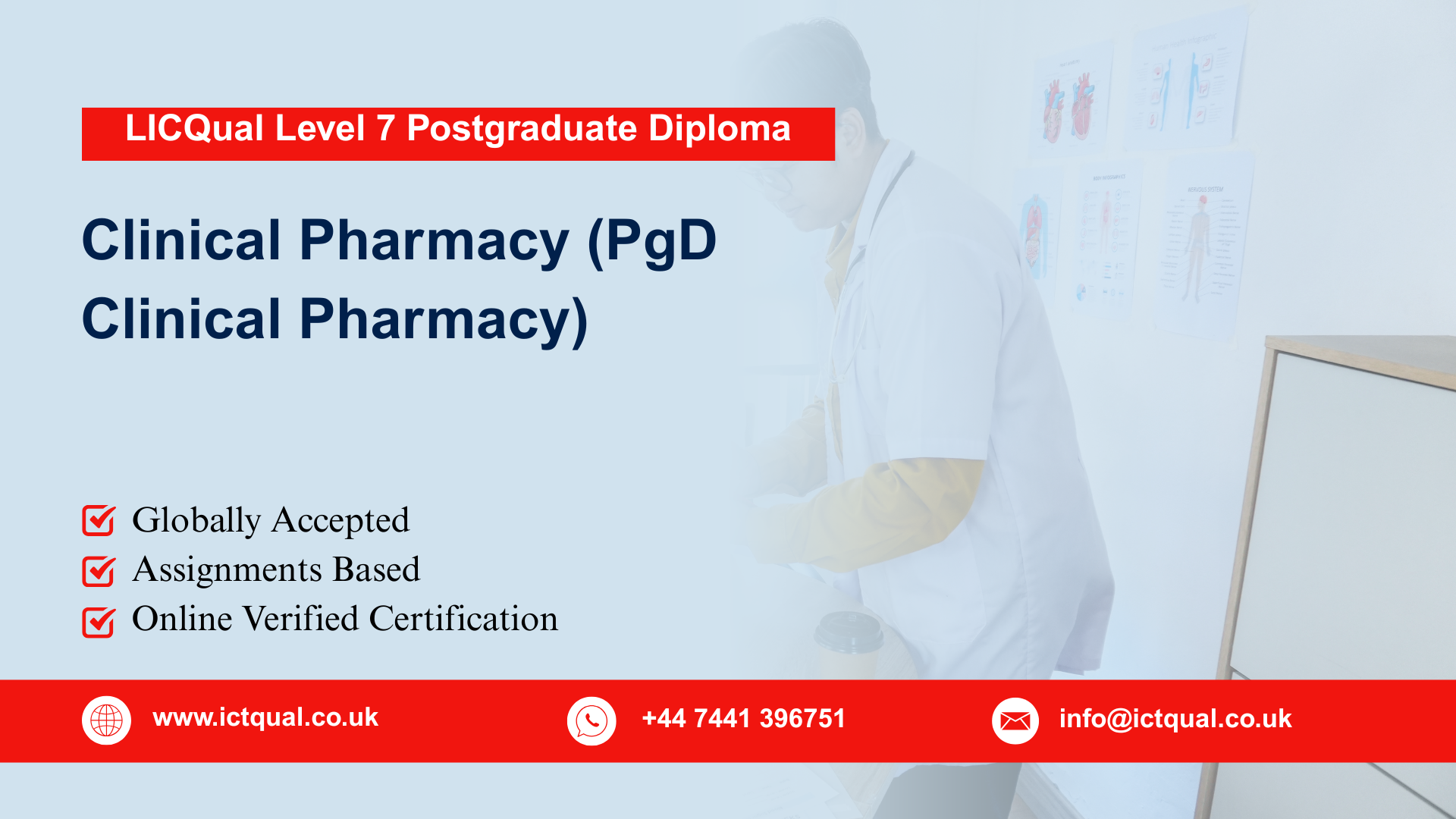
LICQual Level 7 Postgrad Diploma in Clinical Pharmacy
Modern healthcare is evolving rapidly, and with it comes the demand for professionals who can deliver safe, effective, and evidence‑based pharmaceutical care. At the heart of this transformation lies clinical pharmacy, a discipline that ensures medicines are not only prescribed correctly but also optimized for individual patient needs. Clinical pharmacy is about more than dispensing—it is about applying advanced knowledge to improve therapeutic outcomes, reduce risks, and enhance patient safety.
The LICQual Level 7 Postgraduate Diploma in Clinical Pharmacy (PgD Clinical Pharmacy) highlights the growing importance of this field in shaping the future of healthcare. Clinical pharmacy integrates science, practice, and patient‑centered care, making it indispensable in hospitals, community settings, and research institutions worldwide. As healthcare systems face challenges such as complex therapies, drug interactions, and rising patient expectations, professionals trained in clinical pharmacy are vital for bridging the gap between medical science and real‑world patient care. For learners, engaging with this subject is more than academic—it is an opportunity to contribute to life‑saving interventions, strengthen professional credibility, and play a pivotal role in advancing modern healthcare.
Program Outline
The LICQual Level 7 Postgraduate Diploma in Clinical Pharmacy (PgD Clinical Pharmacy) is a structured qualification designed to provide learners with advanced expertise in pharmaceutical care. Comprising 6 specialized units and worth 120 credits, the program introduces learners to areas such as therapeutic drug monitoring, advanced pharmacotherapy, patient safety frameworks, compliance with international standards, healthcare communication, and ethical considerations in clinical pharmacy.
This section explains how the course equips learners with the ability to understand clinical pharmacy, apply evidence‑based approaches, and align with global standards effectively. It highlights the type of learners the program is aimed at, the skills they will gain, and the career pathways available upon completion. Readers will also discover how this internationally recognized qualification opens opportunities in hospitals, community pharmacies, pharmaceutical companies, and research institutions, making it a valuable credential for anyone aspiring to build a career in clinical pharmacy.
Unit Structure
| Qualification | Unit Title | Credits | GLH |
| LICQ2201222-1 | Advanced Clinical Pharmacotherapy | 20 | 100 |
| LICQ2201222-2 | Clinical Decision-Making and Patient-Centred Care | 20 | 100 |
| LICQ2201222-3 | Medication Safety and Quality Improvement in Healthcare | 20 | 100 |
| LICQ2201222-4 | Research Methods and Evidence-Based Practice in Clinical Pharmacy | 20 | 100 |
| LICQ2201222-5 | Leadership and Management in Clinical Pharmacy Practice | 20 | 100 |
| LICQ2201222-6 | Clinical Pharmacy Practice Project | 20 | 100 |
Who Can Benefit
This postgraduate diploma is designed for individuals who want to specialize in advanced pharmaceutical care and patient‑centered practice. The program is particularly valuable for those who aim to address challenges such as drug safety, therapy optimization, and compliance with international standards. It helps learners strengthen their expertise, improve employability, and prepare for roles where advanced pharmacy practice is central to healthcare delivery.
Ideal Learners
- Students aspiring to enter pharmaceutical sciences with a focus on advanced practice.
- Entry‑level professionals seeking structured training in applied pharmaceutical care.
- Pharmacy assistants wanting to expand knowledge of patient care and therapeutic monitoring.
- Community staff preparing for responsibilities in evidence‑based healthcare delivery.
- Hospital technicians aiming to strengthen skills in compliance and patient safety.
- Healthcare professionals transitioning into specialized pharmaceutical roles.
- Career changers interested in pharmaceutical innovation and patient‑centered care.
- Ambitious learners who want to develop practical skills for careers in advanced pharmacy practice.
What You’ll Be Able to Do
Unit 1: Advanced Clinical Pharmacotherapy
By the end of this unit, learners will be able to:
- Critically analyse and apply evidence-based guidelines in complex pharmacotherapy.
- Evaluate therapeutic options for patients with multiple morbidities and polypharmacy.
- Demonstrate advanced understanding of pharmacokinetics and pharmacodynamics in clinical decision-making.
- Assess the risks and benefits of medication therapy to optimise patient outcomes.
- Integrate new drug therapies and clinical evidence into patient management plans.
Unit 2: Clinical Decision-Making and Patient-Centred Care
By the end of this unit, learners will be able to:
- Apply advanced clinical reasoning models in patient-centred pharmaceutical care.
- Design, implement, and critically evaluate personalised care plans.
- Integrate patient values, preferences, and cultural considerations into decision-making.
- Demonstrate ethical and professional judgement in clinical scenarios.
- Collaborate effectively with multidisciplinary teams to improve patient outcomes.
Unit 3: Medication Safety and Quality Improvement in Healthcare
By the end of this unit, learners will be able to:
- Critically evaluate systems and processes that influence medication safety.
- Design and implement strategies to minimise medication errors.
- Apply quality improvement methodologies to pharmacy practice.
- Analyse national and international frameworks for medication safety.
- Lead initiatives that promote a culture of patient safety within healthcare settings.
Unit 4: Research Methods and Evidence-Based Practice in Clinical Pharmacy
By the end of this unit, learners will be able to:
- Critically appraise research methodologies relevant to clinical pharmacy.
- Design and justify a research proposal addressing a practice-based issue.
- Apply statistical and analytical tools to evaluate clinical research data.
- Integrate evidence-based findings into clinical decision-making and service development.
- Demonstrate academic writing and presentation skills appropriate for postgraduate study.
Unit 5: Leadership and Management in Clinical Pharmacy Practice
By the end of this unit, learners will be able to:
- Critically evaluate leadership theories and their application in healthcare.
- Demonstrate advanced skills in managing pharmacy teams and healthcare services.
- Apply strategic thinking to healthcare policy, planning, and resource management.
- Lead interprofessional collaboration to improve patient care delivery.
- Reflect on personal leadership style and its impact on clinical pharmacy practice.
Unit 6: Clinical Pharmacy Practice Project
By the end of this unit, learners will be able to:
- Identify and investigate a significant issue within clinical pharmacy practice.
- Demonstrate independence in research design, data collection, and analysis.
- Apply advanced problem-solving skills to propose evidence-based solutions.
- Critically evaluate project outcomes and their implications for practice.
- Present findings in a professional format suitable for academic and healthcare audiences.