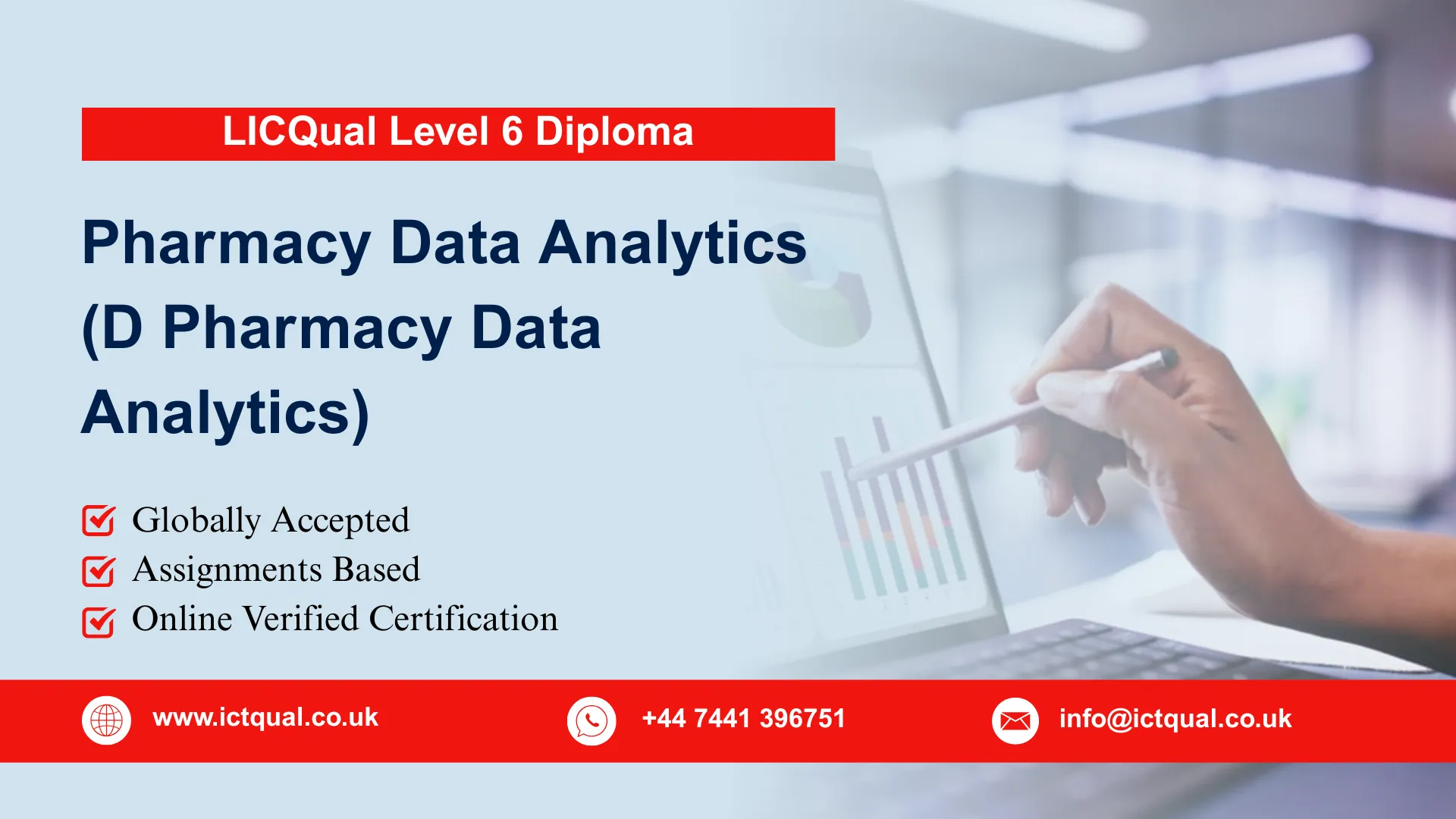
LICQual Level 6 Diploma in Pharmacy Data Analytics 📊💊
In the modern healthcare landscape, data has become the driving force behind innovation, efficiency, and patient safety. Every prescription, clinical trial, and patient interaction generates valuable information that can transform the way medicines are delivered and healthcare systems operate. This is where pharmacy data analytics plays a critical role. By harnessing advanced analytical tools, professionals can uncover patterns, predict outcomes, and make evidence‑based decisions that improve patient care and optimize pharmaceutical services.
The LICQual Level 6 Diploma in Pharmacy Data Analytics (D Pharmacy Data Analytics) highlights the growing importance of data‑driven approaches in pharmacy practice. Pharmacy data analytics is not just about numbers—it is about translating complex datasets into actionable insights that enhance compliance, reduce risks, and support innovation. As healthcare systems worldwide increasingly rely on digital technologies and big data, professionals trained in this discipline are essential for bridging clinical expertise with analytical precision. For learners, engaging with this subject is more than academic—it is an opportunity to contribute to smarter healthcare systems, strengthen professional credibility, and play a pivotal role in shaping the future of pharmaceutical care.
Program Outline
The LICQual Level 6 Diploma in Pharmacy Data Analytics (D Pharmacy Data Analytics) is a structured qualification designed to provide learners with advanced knowledge of data analysis in pharmacy practice. Comprising 6 specialized units and worth 120 credits, the program introduces learners to areas such as statistical modeling, healthcare informatics, compliance frameworks, patient safety monitoring, predictive analytics, and international standards in pharmacy data analytics.
This section explains how the course equips learners with the ability to understand pharmacy data analytics, apply evidence‑based approaches, and align with global standards effectively. It highlights the type of learners the program is aimed at, the skills they will gain, and the career pathways available upon completion. Readers will also discover how this internationally recognized qualification opens opportunities in hospitals, pharmaceutical companies, healthcare organizations, and research institutions, making it a valuable credential for anyone aspiring to build a career in pharmacy data analytics.
Unit Structure
| Qualification | Unit Title | Credits | GLH |
| LICQ2201220-1 | Fundamentals of Pharmacy Data Analytics | 20 | 80 |
| LICQ2201220-2 | Data Collection, Management, and Governance | 20 | 80 |
| LICQ2201220-3 | Statistical Analysis and Interpretation | 20 | 80 |
| LICQ2201220-4 | Predictive Analytics and Modelling | 20 | 80 |
| LICQ2201220-5 | Data Visualization and Reporting | 20 | 80 |
| LICQ2201220-6 | Research, Innovation, and Continuing Professional Development (CPD) | 20 | 80 |
Who Can Benefit
The LICQual Level 6 Diploma in Pharmacy Data Analytics (D Pharmacy Data Analytics) is designed for individuals who want to specialize in data‑driven decision‑making within pharmacy practice. This program is particularly valuable for those who aim to address challenges such as patient safety, compliance, and healthcare efficiency through analytics. It helps learners strengthen their expertise, improve employability, and prepare for roles where pharmacy data analytics is central to healthcare delivery.
Ideal Learners
- Students aspiring to enter pharmaceutical sciences with a focus on data analysis.
- Entry‑level professionals seeking structured training in pharmacy data analytics.
- Pharmacy assistants wanting to expand knowledge of patient data and compliance.
- Community pharmacy staff preparing for responsibilities in healthcare informatics.
- Hospital pharmacy technicians aiming to strengthen skills in monitoring and reporting.
- Healthcare professionals transitioning into pharmacy data analytics roles.
- Career changers interested in healthcare innovation and digital transformation.
- Ambitious learners who want to develop practical skills for pharmacy data analytics careers.
What You’ll Be Able to Do
Unit 1: Fundamentals of Pharmacy Data Analytics
By the end of this unit, learners will be able to:
- Analyse the role and significance of data analytics in pharmacy and healthcare
- Identify key data types, sources, and structures relevant to pharmacy practice
- Evaluate the impact of data analytics on operational efficiency and patient outcomes
Unit 2: Data Collection, Management, and Governance
By the end of this unit, learners will be able to:
- Implement best practices for data collection, storage, and management in pharmacy settings
- Apply data governance principles, ensuring compliance with privacy and regulatory requirements
- Maintain data integrity, accuracy, and security in healthcare environments
Unit 3: Statistical Analysis and Interpretation
By the end of this unit, learners will be able to:
- Apply statistical methods to analyse pharmacy and healthcare data
- Identify trends, patterns, and correlations to support informed decision-making
- Evaluate operational performance and patient care outcomes using statistical tools
Unit 4: Predictive Analytics and Modelling
By the end of this unit, learners will be able to:
- Develop predictive models to forecast trends in pharmacy and healthcare operations
- Apply data-driven and machine learning approaches to assess risks and optimise processes
- Utilise predictive analytics to support proactive and evidence-based decision-making
Unit 5: Data Visualisation and Reporting
By the end of this unit, learners will be able to:
- Create clear and actionable data visualisations to communicate complex information
- Produce reports that effectively inform stakeholders and support decision-making
- Utilise dashboards and business intelligence tools to present insights in pharmacy practice
Unit 6: Research, Innovation, and Continuing Professional Development (CPD)
By the end of this unit, learners will be able to:
- Conduct research projects to enhance pharmacy operations and patient outcomes
- Implement innovative strategies and analytical approaches in pharmacy data analytics
- Engage in Continuing Professional Development (CPD) to maintain expertise and advance professional capabilities