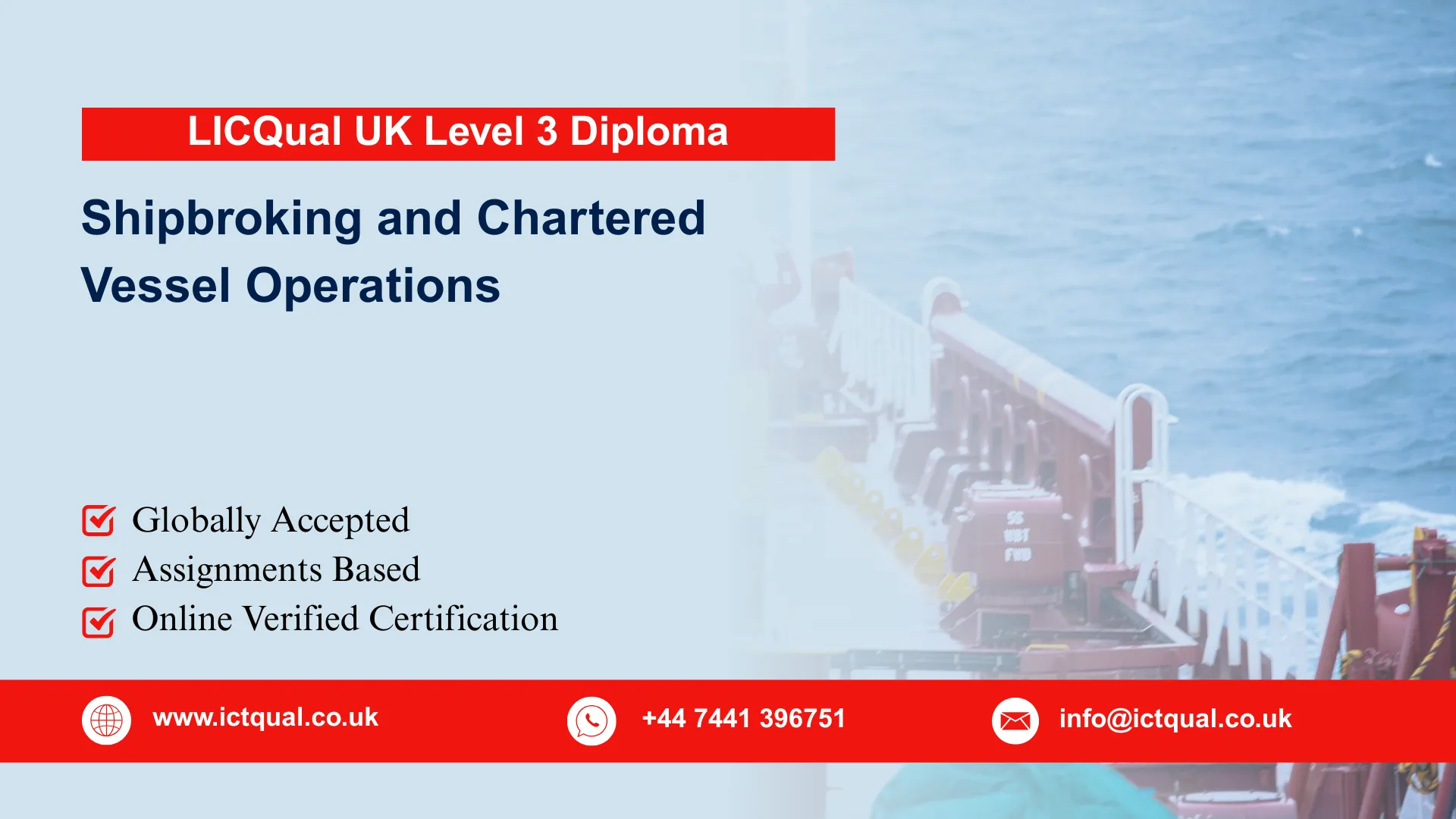
LICQual UK Level 3 Shipbroking & Vessel Operations Diploma
Shipbroking and chartered vessel operations are at the core of international trade, connecting shipowners, charterers, and global markets. Every contract signed and every vessel chartered represents a vital decision that impacts the movement of goods, energy, and resources across continents. In this dynamic industry, professionals must understand negotiation, contracts, and maritime law while balancing commercial demands with operational efficiency.
The LICQual UK Level 3 Diploma in Shipbroking and Chartered Vessel Operations highlights the importance of building strong foundations in this specialized field. Shipbrokers act as the bridge between shipping companies and clients, ensuring vessels are matched with cargoes efficiently and profitably. Chartered vessel operations, meanwhile, require precision in planning, compliance, and execution. As global trade continues to expand, the demand for skilled professionals who can navigate the complexities of shipping contracts and vessel management has never been greater. For learners, mastering shipbroking and chartered vessel operations opens the door to a career that directly shapes the future of maritime commerce.
Program Outline
The LICQual UK Level 3 Diploma in Shipbroking and Chartered Vessel Operations is a structured qualification designed to provide learners with essential knowledge and practical skills in maritime commerce. Comprising 6 specialized units and worth 60 credits, the program introduces learners to the fundamentals of shipbroking, vessel chartering, and international shipping practices.
This section of the article explains how the diploma equips learners with the ability to understand contracts, negotiate agreements, and manage vessel operations effectively. It highlights the type of learners the course is aimed at, the skills they will gain, and the career pathways available upon completion. Readers will also discover how this internationally recognized qualification opens opportunities in shipbroking firms, chartering companies, logistics organizations, and global trade enterprises, making it a valuable credential for anyone aspiring to build a career in shipbroking and chartered vessel operations.
Unit Structure
| Qualification | Unit Title | Credits | GLH |
| LICQ2201289-1 | Introduction to Shipbroking and Maritime Trade | 10 | 40 |
| LICQ2201289-2 | Fundamentals of Vessel Types and Shipping Markets | 10 | 40 |
| LICQ2201289-3 | Principles of Chartering and Voyage Planning | 10 | 40 |
| LICQ2201289-4 | Shipping Documentation and Trade Procedures | 10 | 40 |
| LICQ2201289-5 | Cargo Handling, Safety, and Port Operations | 10 | 40 |
| LICQ2201289-6 | Professional Skills for Shipbroking Careers | 10 | 40 |
Who Can Benefit
The LICQual UK Level 3 Diploma in Shipbroking and Chartered Vessel Operations is designed for individuals who want to enter or progress in the maritime and shipping industry. This program is especially valuable for those who face challenges such as understanding complex contracts, managing vessel operations, or meeting compliance standards. It helps learners gain confidence, improve employability, and prepare for roles where shipbroking and chartered vessel operations are central to global trade.
Ideal Learners
- Students aspiring to start a career in shipbroking and vessel chartering.
- Entry‑level professionals seeking structured training in maritime contracts and negotiations.
- Shipping company staff who want to strengthen their knowledge of charter agreements.
- Logistics employees preparing for international shipping and trade roles.
- Port authority staff aiming to expand their expertise in vessel operations.
- Trade and transport professionals transitioning into maritime commerce.
- Career changers looking for an internationally recognized qualification in shipbroking.
- Ambitious learners who want to develop practical skills for global shipping opportunities.
What You’ll Be Able to Do
1. Introduction to Shipbroking and Maritime Trade
Learners will be able to:
- Explain the role of shipbrokers in global shipping and maritime trade.
- Identify the key stakeholders in shipbroking, including shipowners, charterers, and traders.
- Demonstrate understanding of the fundamentals of international shipping markets.
- Analyze the importance of shipbroking in facilitating global commerce.
- Recognize career opportunities and pathways in shipbroking and vessel operations.
- Apply basic principles of negotiation and communication in shipbroking contexts.
2. Fundamentals of Vessel Types and Shipping Markets
Learners will be able to:
- Differentiate between major vessel types such as bulk carriers, tankers, and container ships.
- Explain how vessel design impacts cargo capacity, trade routes, and operations.
- Analyze the dynamics of global shipping markets and freight rate fluctuations.
- Demonstrate understanding of supply and demand factors in maritime trade.
- Evaluate the role of shipbrokers in matching vessels with cargoes.
- Apply knowledge of vessel types to real‑world chartering scenarios.
3. Principles of Chartering and Voyage Planning
Learners will be able to:
- Explain the different types of charter agreements, including voyage and time charters.
- Apply knowledge of voyage estimation and costing in chartering decisions.
- Demonstrate understanding of laytime, demurrage, and dispatch in contracts.
- Analyze the role of shipbrokers in negotiating charter party terms.
- Evaluate the importance of voyage planning for operational efficiency.
- Recognize the impact of global trade routes on chartering strategies.
4. Shipping Documentation and Trade Procedures
Learners will be able to:
- Identify and explain key shipping documents such as bills of lading and charter parties.
- Demonstrate understanding of customs clearance and international trade compliance.
- Apply knowledge of Incoterms in shipping and trade contracts.
- Evaluate the importance of accurate documentation in reducing trade risks.
- Recognize the role of digitalization in modern shipping documentation.
- Analyze the impact of trade procedures on global logistics efficiency.
5. Cargo Handling, Safety, and Port Operations
Learners will be able to:
- Demonstrate knowledge of international safety standards in cargo handling.
- Apply risk assessment techniques to ensure safe vessel and port operations.
- Explain the role of ports in supporting global shipping and logistics.
- Evaluate the importance of cargo stowage, loading, and unloading procedures.
- Recognize the impact of technology and automation on port operations.
- Promote a culture of safety and compliance in maritime environments.
6. Professional Skills for Shipbroking Careers
Learners will be able to:
- Demonstrate effective communication and negotiation skills in shipbroking.
- Apply problem‑solving and decision‑making skills to maritime trade challenges.
- Recognize the importance of ethics and compliance in shipbroking practices.
- Develop employability skills required for entry‑level roles in shipbroking and logistics.
- Apply continuous learning strategies to support career growth in maritime trade.
- Build confidence in applying theoretical knowledge to real‑world shipbroking scenarios.